
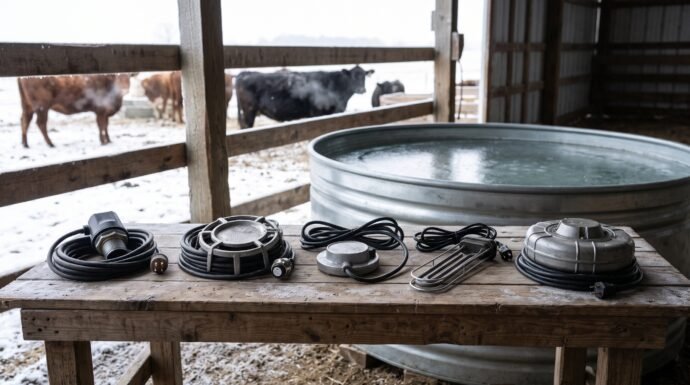
4 Best Water Trough Heaters for Livestock (2026)
Short answer: for a full-size stock tank in a cold winter, the API 1,500 watt floating de-icer is the pick from this group: it has the most heating power here, a thermostat that switches on near freezing and a steel-coil cord protector. The Farm Innovators H-418C, at 1,250 watts, is the more flexible choice because it works floating or sunk. For small tubs up to about 25 gallons, the 500 watt Farm Innovators C-500 is enough and uses far less power.
How we chose
We have not used these heaters on our own stock tanks. The picks are based on manufacturer specifications, product pages and owner feedback, compared against what a trough heater has to do: keep an opening in the ice in your coldest weather, run only when needed, be safe in the tank material you use and survive animals pushing, rubbing and chewing. Check each heater’s tank-size and plastic-tank guidance before you buy.
Quick comparison
| Heater | Watts | Mounting | Best for | Not for |
|---|---|---|---|---|
| API 7521 floating de-icer | 1,500 W | Floating, thermostat, steel-coil cord guard | Large tanks in cold climates | Weak or shared circuits |
| Farm Innovators H-418C | 1,250 W | Floating or submerged, cast aluminum | Large metal or plastic tanks, flexible placement | Very small tubs |
| Drain-plug stock tank heater | Check listing | Fits a compatible tank drain hole | Rubbermaid-style tanks, keeping the heater out of reach | Tanks without a matching drain |
| Farm Innovators C-500 | 500 W | Submerged, cast aluminum | Tubs and small tanks up to about 25 gal | Big troughs in hard freezes |
Best for large tanks: API 7521 floating de-icer, 1,500 W

The API 7521 floats at the surface, which is where ice forms, and its built-in thermostat turns it on as the water nears freezing. At 1,500 watts it is the most powerful unit here, which helps on big tanks, in wind and in sustained deep cold. The listing describes a safety shut-off and a steel-coil cord protector to slow chewing and wear.
Drawbacks: 1,500 watts draws roughly 12.5 amps on a 120-volt circuit, so it needs a circuit and extension cord that can carry that load, ideally on its own. A floating heater can be knocked about or pulled out by curious animals, especially horses, unless it is guarded. Running cost adds up over a long winter.
Skip it if: your tank is small or your power supply is limited. A lower-wattage heater is safer and cheaper there.
Most flexible: Farm Innovators H-418C, 1,250 W
No products found.
The H-418C converts between floating and submerged use, so you can float it in a deep tank or sink it to the bottom where animals cannot reach it. Farm Innovators lists 1,250 watts, cast-aluminum construction, thermostatic control, an anti-chew cord protector, suitability for plastic tanks and a three-year guarantee.
Drawbacks: at 1,250 watts it still needs a solid circuit. Submerged, it heats the bottom first, so surface ice can still form in extreme cold until the water warms through. The cord still needs routing out of reach.
Skip it if: you water from buckets or small tubs. The C-500 is a better fit.
Out of the way: drain-plug stock tank heater
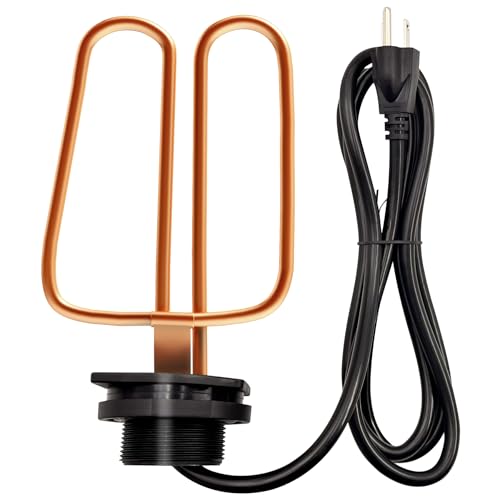
This style of heater threads into the drain opening of a compatible poly stock tank, such as many Rubbermaid models, so nothing floats in the water and animals cannot grab it. The listing advertises a thermostat and sealed construction.
Drawbacks: it only fits tanks with a matching drain hole and design. Information comes from a third-party listing rather than a manufacturer spec sheet, so confirm wattage, electrical protection, tank compatibility and warranty before buying.
Skip it if: your tank has no compatible drain, or you use a metal trough.
For small tanks and tubs: Farm Innovators C-500, 500 W

A 500-watt cast-aluminum de-icer with a thermostat that sits on the bottom of the container. Farm Innovators describes it as safe for plastic and recommends it for containers up to 25 gallons. It suits goat, sheep and poultry tubs or a small horse tank in a moderate climate.
Drawbacks: 500 watts is not enough to keep a large trough open in hard freezes. The cord exits over the rim, so it needs protecting from chewing.
Skip it if: you water cattle from a 100-gallon or larger tank in a cold region.
How to choose a stock tank heater
- Wattage for tank size and climate: roughly 250 to 500 W for buckets and tubs, 1,000 to 1,500 W for 100 gallons and up. Colder, windier sites need the higher end.
- Floating, sunk or drain-plug: floating heaters work right where ice forms; submerged and drain-plug heaters are harder for animals to reach.
- Tank material: in poly tanks, use only heaters the maker states are safe for plastic, and keep them away from the walls as instructed.
- Thermostat: all units here have one. It saves power by running only near freezing.
- Cord protection: look for a steel-coil or anti-chew guard, and still route the cord through conduit or PVC pipe out of reach.
Safety and practical tips
- Plug into a GFCI-protected outdoor outlet, and use a heavy-gauge outdoor cord rated for the heater’s wattage.
- Never run the heater in an empty or nearly empty tank; most are designed to be fully submerged or floating in water.
- If animals refuse to drink, check for stray voltage. A tingle from a faulty heater or poor grounding can stop livestock drinking.
- An insulated tank or partial cover cuts heat loss and running cost, while leaving enough open water for every animal.
- Check the tank daily in freezing weather. A tripped breaker or failed heater can freeze a tank overnight.
Frequently asked questions
What wattage stock tank heater do I need?
For small tubs and buckets, 250 to 500 watts is usually enough. For tanks of about 100 gallons and larger, most owners use 1,000 to 1,500 watts. Cold, windy sites and long sub-freezing spells push toward the higher end. A thermostat means a bigger heater only runs as much as needed, but your circuit must still handle its full load.
Can I use a stock tank heater in a plastic tank?
Only if the maker says the model is safe for plastic, and only installed as instructed. The Farm Innovators C-500 and H-418C are both listed as suitable for plastic tanks. Drain-plug heaters are designed specifically for compatible poly tanks. Keep heaters off the tank walls and never let one run dry.
How much does it cost to run a trough heater?
It depends on wattage, how many hours the thermostat keeps it on and your power price. A 1,500 watt heater uses 1.5 kWh per hour it runs. In mild cold it may cycle only a few hours a day; in deep cold it can run most of the day. Tank insulation and covers reduce run time.
Why won’t my animals drink from a heated tank?
The most common cause is stray voltage, a small electric shock from a damaged heater, cord or poor grounding. Unplug the heater and see if the animals start drinking. Inspect cords for chew damage, use a GFCI outlet and replace any heater with cracks or exposed wiring. Very warm water can also put some animals off.
Verdict by buyer type
- Large cattle or horse tank, cold climate: API 7521, 1,500 W.
- Want floating or sunk, plastic-tank safe: Farm Innovators H-418C.
- Compatible poly tank, heater out of reach: drain-plug heater, after confirming fit.
- Small tubs for goats, sheep or poultry: Farm Innovators C-500.
Related guides
- Best solar electric fence chargers for livestock
- Best livestock scales for weighing cattle
- Best feed grinders for livestock
- Best utility wagons for farm hauling
Last update on 2026-11-16/Affiliate links / Images from Amazon Product Advertising API





One Comment