Smart Planting System : The 5 Best Walk Behind Seeder for Food Plots (2026)
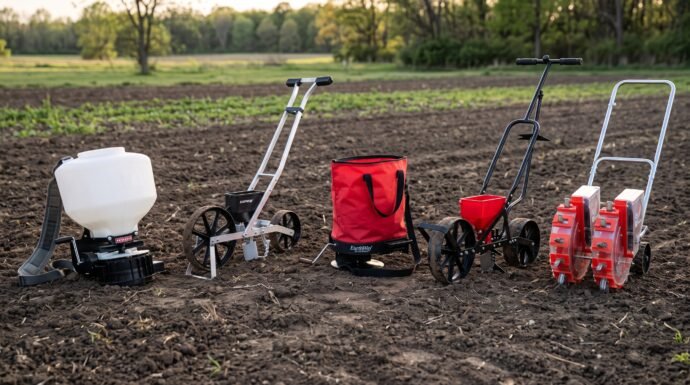
Comparing the 5 best walk behind seeder for food plots. These five products serve different planting needs. The EarthWay Precision Garden Seeder and CHAPIN 8701B are genuine push seeders for planting individual rows. The SOLO and EarthWay Nylon Bag models are broadcast spreaders, while the Groviia is a multi-row seed-and-fertilizer planter.
For food plots, this distinction matters. If you’re planting clover, brassicas, turnips, or other small seeds across an open plot, a broadcast spreader may be more practical. If you’re planting corn, beans, or other crops in rows, a push planter is generally the better type of equipment.
Table of Contents
At a Glance
| Product | Verified Features | Ideal Use |
|---|---|---|
| SOLO 421 Chest-Mount Spreader | 20-lb capacity, directional control, adjustable flow | Broadcasting seed over irregular terrain |
| EarthWay Precision Garden Seeder | Interchangeable seed plates, adjustable furrow depth, row marker | Accurate row planting |
| EarthWay 2750 Nylon Bag Seeder | Nylon hopper, rocking agitator, hand-crank operation | Small plots and uneven terrain |
| CHAPIN 8701B Push Garden Seeder | Six seed plates, steel frame, row marker | Vegetable and row-crop planting |
| Groviia Dual-Bin Seed Planter | Seven outlets, separate seed and fertilizer bins, adjustable seed settings | Multi-row planting and fertilizing |
Top 5 Best Walk Behind Seeder for Food Plots
1. SOLO Capacity Portable Mount Spreader

Overview
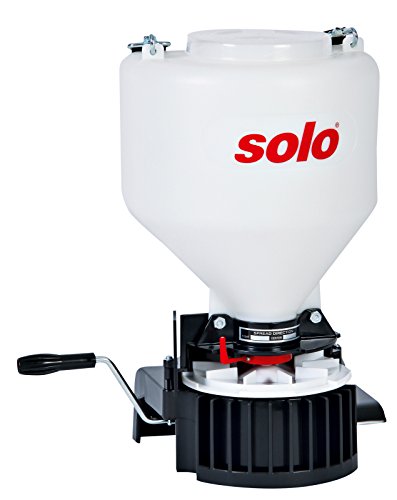
The SOLO 421 is a chest-mounted broadcast spreader rather than a traditional walk-behind planter. Its 20-pound hopper and adjustable distribution controls make it useful for spreading seed across food plots where pushing a wheeled spreader may be inconvenient.
It is particularly worth considering when working around established vegetation, irregular ground, or areas that are difficult to access with larger equipment. The cross-shoulder strap supports portable operation, while directional controls help manage where material is distributed.
For hunters maintaining clover, grass, or other broadcast-seeded food plots, this is a practical alternative to a push-style seeder.
5 Key Features
- 20-pound hopper capacity: Holds a useful quantity of granular material, reducing the frequency of refills.
- Adjustable flow control: Fingertip controls allow the operator to regulate material output.
- Directional spreading: Distribution can be directed toward the center, left, or right.
- Corrosion-resistant gearbox: The enclosed gearbox is designed to protect its internal mechanism.
- Cross-shoulder carrying strap: Supports comfortable carrying while walking over uneven ground.
Pros
- Portable design for irregular terrain.
- Useful for broadcasting different types of seed.
- Adjustable material flow and distribution direction.
- Large opening makes filling and cleaning easier.
Cons
- Requires carrying the hopper while operating.
- Does not create furrows or cover seed with soil.
2. EarthWay Precision Garden Seeder
No products found.
Overview
The EarthWay Precision Garden Seeder is a push-operated row planter designed for accurate seed placement. Unlike broadcast spreaders, it opens a furrow, meters seeds at intervals, covers the planted row, and marks the next row.
Its interchangeable seed plates make it suitable for a variety of garden crops and row-planted food plot varieties. The adjustable furrow plow also allows planting depth to be controlled.
The manufacturer specifies that the seeder is intended for properly prepared, well-tilled soil. This is an important consideration for anyone maintaining food plots without extensive field preparation.
For buyers who want organized rows instead of broadcasting seed across an entire field, this is one of the more appropriate options in this comparison.
5 Key Features
- Interchangeable seed plates: Different plates accommodate different seed types and planting requirements.
- Adjustable furrow plow: Helps control planting depth.
- Integrated seed placement: Meters seeds at intervals rather than distributing them randomly.
- 30-inch row marker: Helps maintain consistent spacing between planting rows.
- Lightweight aluminum construction: Provides a rust-resistant frame for garden planting.
Pros
- More controlled seed placement than broadcast spreading.
- Opens and covers furrows in one operation.
- Interchangeable plates increase crop versatility.
- Row marker helps maintain organized planting patterns.
Cons
- Requires properly prepared, well-tilled soil.
- Less suitable for quickly broadcasting seed across large food plots.
3. EarthWay Nylon Bag Seeder
No products found.
Overview
The EarthWay 2750 Nylon Bag Seeder is a manually operated broadcast spreader designed for carrying and distributing seed without pushing a wheeled machine.
Its flexible nylon hopper, shoulder strap, and hand-crank mechanism make it particularly useful on uneven or wet ground. The integrated rocking agitator helps feed material toward the distribution plate, while the operator controls spreading by adjusting the crank speed.
This design makes it a useful option for hunters who maintain smaller food plots or need to spread seed in locations where wheeled equipment is inconvenient.
It is important to understand that this is a broadcast spreader, not a precision row planter.
5 Key Features
- Nylon hopper: The weather-resistant, tear-resistant bag can be collapsed for storage.
- Hand-crank operation: Allows the operator to control material distribution while walking.
- Rocking agitator: Helps maintain consistent material feeding.
- Adjustable spreading width: Changing crank speed adjusts distribution, with manufacturer-related product information describing an approximately 8–12-foot spreading range.
- Spring-loaded shutoff: Helps stop material flow when spreading is not required.
Pros
- Portable for remote food plot locations.
- Suitable for uneven and wet terrain.
- Collapsible bag simplifies storage.
- Hand-crank operation provides direct control over spreading.
Cons
- Requires continuous manual cranking.
- Does not provide precise row spacing or seed burial.
4. CHAPIN 8701B Push Garden Seeder
No products found.
Overview
The CHAPIN 8701B is a manual push garden seeder designed to simplify row planting. It combines furrow preparation, seed placement, and soil covering in a single pass.
Its six interchangeable seed plates accommodate a range of vegetable seed types. The powder-coated steel frame provides structural support, while the adjustable row marker helps maintain consistent planting distances.
One useful difference between this model and broadcast spreaders is that it places seed into a prepared furrow rather than distributing seed across the soil surface.
For food plot owners planting crops such as corn, beans, and suitable brassicas in rows, the Chapin offers a straightforward manual planting system.
5 Key Features
- Six interchangeable seed plates: Designed to accommodate up to 20 different seed types and sizes.
- Zinc-plated plow blade: Opens the soil to create a planting furrow.
- Rear covering wheel: Helps cover planted seed with soil.
- Adjustable row marker: Assists with maintaining consistent row spacing.
- Powder-coated steel frame: Provides a durable structural platform for manual operation.
Pros
- Combines furrow opening, seeding, and covering.
- Multiple seed plates accommodate different crops.
- Adjustable row marker helps organize planting.
- Manual push operation does not require fuel or electricity.
Cons
- Works best in cultivated soil.
- Not designed for broadcasting seed over large open areas.
5. Groviia Dual-Bin Seed Planter

Overview
The Groviia Dual-Bin Seed Planter is a manual push-operated planter designed to distribute seed and fertilizer in the same pass.
Its dual-bin arrangement separates the two materials, while seven outlets are intended to distribute seed across multiple planting positions. The available product listing describes nine-inch plant spacing and adjustable seed-count settings.
This arrangement may be useful for buyers who want to establish multiple crop rows without making separate planting and fertilizer application passes.
However, the available product information is primarily retailer-supplied. Buyers should verify seed compatibility, outlet spacing, fertilizer adjustment, and replacement-part availability before purchasing.
5 Key Features
- Dual-bin arrangement: Separate compartments are provided for seed and fertilizer.
- Seven planting outlets: Designed to distribute seed across multiple planting positions.
- Nine-inch stated spacing: The listing identifies nine-inch plant spacing.
- Adjustable seed settings: Allows the operator to change the intended seed output.
- Manual push design: Uses a wheeled frame for walking operation without a powered engine.
Pros
- Separate seed and fertilizer compartments.
- Multiple planting outlets.
- Designed to combine planting and fertilizer application.
- Manual operation does not require an engine.
Cons
- Independent performance information is limited.
- Seed compatibility and fertilizer calibration should be confirmed before purchase.
Final Verdict
Choosing the best walk-behind seeder for food plots depends primarily on the type of seed you plan to plant and how you prepare the ground.
Best for broadcasting seed: SOLO 421
The SOLO 421 is a strong option for hunters who want to distribute seed while walking through irregular terrain. Its adjustable flow and directional controls are useful for smaller food plots and areas inaccessible to wheeled equipment.
Best for precision row planting: EarthWay Precision Garden Seeder
The EarthWay Precision Garden Seeder is a better choice for buyers who prioritize controlled seed spacing and planting depth. Its interchangeable plates and integrated furrow system make it particularly useful for row crops.
Best for portable broadcasting: EarthWay 2750 Nylon Bag Seeder
The EarthWay 2750 is worth considering for smaller food plots, uneven ground, and locations where carrying a spreader is more practical than pushing one.
Best for straightforward manual planting: CHAPIN 8701B
The Chapin combines several planting operations into one pass. It is a practical option for people planting vegetables and other suitable row crops in prepared soil.
Best for combined seed and fertilizer application: Groviia Dual-Bin Planter
The Groviia stands out for its separate seed and fertilizer compartments. However, its specifications and compatibility should be confirmed before purchasing.
Best For Comparison
| Buyer Scenario | Recommended Product | Why |
|---|---|---|
| Broadcasting clover and grass seed | SOLO 421 | Portable design and adjustable spreading controls |
| Planting vegetable rows | EarthWay Precision Seeder | Controlled seed spacing and furrow depth |
| Spreading seed on uneven ground | EarthWay 2750 | Shoulder-carried nylon hopper |
| Planting in prepared garden soil | CHAPIN 8701B | Opens, plants, and covers rows |
| Planting and fertilizing together | Groviia | Separate seed and fertilizer compartments |
Frequently Asked Questions
1. What is the best type of seeder for a small deer food plot?
It depends on the seed. Broadcast spreaders are generally more convenient for distributing small seeds such as clover and brassicas across an open plot. Push seeders are more appropriate when planting crops in organized rows.
2. Is a walk-behind seeder better than a broadcast spreader?
Neither is universally better. A walk-behind precision seeder provides more controlled seed placement and spacing. A broadcast spreader covers open ground more conveniently, particularly when planting small seeds.
3. Can I use the EarthWay Precision Garden Seeder for food plots?
Yes, provided the crop is compatible with its seed plates and the soil is properly prepared. It is particularly suitable for crops planted in rows.
4. Which is better for uneven food plot terrain, the SOLO or EarthWay 2750?
Both are portable broadcast spreaders. The SOLO has a rigid chest-mounted hopper, while the EarthWay 2750 uses a flexible nylon bag. Both avoid the need to push a wheeled spreader.
5. Do push seeders work in no-till food plots?
Most conventional push garden seeders work best in prepared, cultivated soil. Hard, compacted, or residue-covered ground can prevent the furrow opener from penetrating consistently. A no-till drill or an appropriately designed no-till planter may be more suitable.
Last update on 2026-11-05/Affiliate links / Images from Amazon Product Advertising API