5 Best Broadcast Spreaders for Fertilizer (2026)
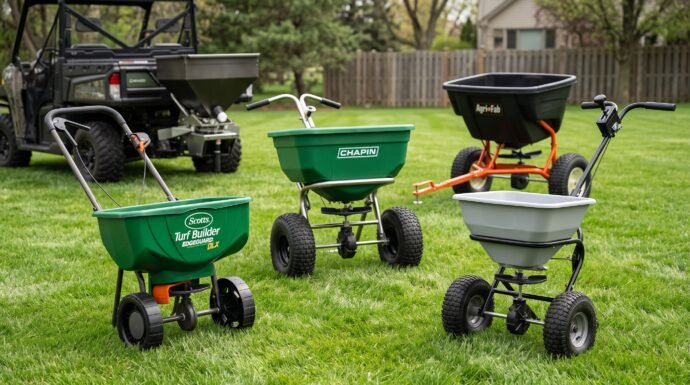
Short answer: for a typical home lawn up to about a third of an acre, the Scotts Turf Builder EdgeGuard DLX is the pick: it is pre-calibrated for Scotts products and has an edge guard that keeps fertilizer off driveways and beds. For bigger lawns pushed by hand, the CHAPIN TurfPro 100 lb holds far more and is built heavier. If you own a riding mower or garden tractor and have half an acre or more, the Agri-Fab 130 lb tow-behind saves the most time.
How we chose
We have not spread fertilizer with these units ourselves. The picks are based on manufacturer specifications, product listings and owner feedback, compared against what a fertilizer spreader has to do: carry enough for your lawn without constant refills, meter granules evenly so you do not get stripes or burn, and keep product off hard surfaces and water. Check the current listing before you buy, because specifications and included parts change.
Quick comparison
| Spreader | Type | Capacity / coverage (listed) | Best for | Not for |
|---|---|---|---|---|
| Scotts EdgeGuard DLX | Push | Up to 15,000 sq ft of Scotts product | Small to medium lawns with beds and paths | Lawns over about 1/3 acre |
| CHAPIN TurfPro 89303C | Push | 100 lb, about 22,000 sq ft | Large lawns, frequent use | Lime, sand or rock salt |
| Titan Attachments 70 lb | Push | 70 lb, 10 to 12 ft spread width | Mid-size lawns, seed and ice melt too | Precise rates (only four flow settings) |
| Agri-Fab 130 lb | Tow-behind | 130 lb, about 25,000 sq ft per fill | Half an acre and up with a mower or tractor | Small yards, tight gates |
| JUKASO ATV/UTV | Receiver-mount, 12 V | About 80 lb grain or 200 lb salt (listed) | Pastures, food plots and acreage | Lawns without an ATV or UTV |
Best for most home lawns: Scotts Turf Builder EdgeGuard DLX

This is the spreader most homeowners should start with. It holds enough Scotts product for about 15,000 square feet, arrives calibrated with the settings printed on Scotts bags, and the EdgeGuard flap blocks the right side of the spread pattern so you can run along a sidewalk or flower bed without throwing granules onto it. It also handles grass seed and ice melt.
Drawbacks: the hopper is small for larger yards, so you will refill often past a third of an acre. Settings are matched to Scotts products, so with other brands you need to calibrate yourself. Scotts’ published information lists no mechanical warranty.
Skip it if: you have more than about 15,000 square feet to cover or use mostly non-Scotts fertilizer.
Best push spreader for big lawns: CHAPIN TurfPro 89303C
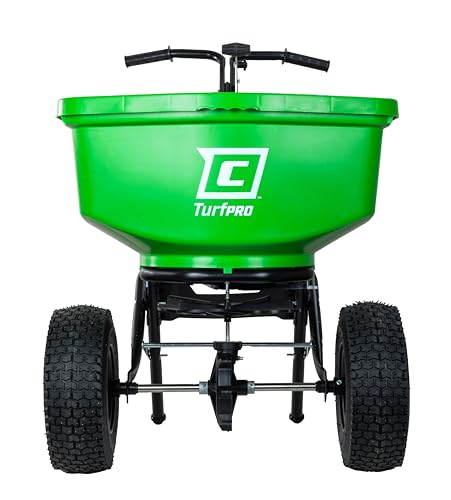

The TurfPro is a step up in build: a 100 lb poly hopper on a powder-coated steel frame, stainless steel axle, gears and gate linkage, an enclosed metal gearbox and 12-inch pneumatic tires. Chapin lists coverage of about 22,000 square feet per fill, and directional controls let you narrow the pattern near edges. It carries a five-year limited warranty.
Drawbacks: Chapin advises against using it with rock salt, sand and lime, so it is not a do-everything spreader. There is no rain cover included. A full 100 lb hopper is heavy to push uphill or on soft ground.
Skip it if: you need to spread lime or winter salt, or your lawn is small enough that a Scotts-size hopper is enough.
Mid-size option: Titan Attachments 70 lb

The Titan sits between the Scotts and the Chapin. It holds 70 lb, throws a listed 10 to 12 foot width, rolls on 10 x 3.5 inch pneumatic tires and comes with a hopper screen and rain cover. The maker describes it for fertilizer, seed and ice melt.
Drawbacks: four flow positions give coarse control, so dialing in a precise fertilizer rate takes calibration. There is no edge guard for working along beds and paths. It is still a push spreader, so large properties mean a lot of walking.
Skip it if: you need fine rate control near landscaping. The Scotts or Chapin handle edges better.
Best with a riding mower or tractor: Agri-Fab 130 lb tow-behind
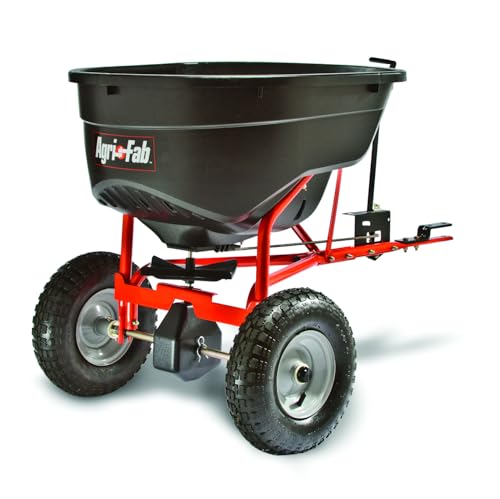
If you already mow with a lawn tractor, this is the time saver. The 130 lb poly hopper covers about 25,000 square feet, or roughly half an acre, per fill. It hooks to a universal hitch, has an enclosed gearbox and rides on large pneumatic tires. On an acre or more, it turns an hour of pushing into a short drive.
Drawbacks: it needs a compatible mower or tractor, and it takes up more storage space than a push spreader. There is no edge guard, so you will still trim edges by hand or with a smaller spreader. Ground speed affects the rate, so keep a steady pace.
Skip it if: your lawn is under a third of an acre or you do not own a towing vehicle.
For acreage with an ATV or UTV: JUKASO receiver-mount spreader
No products found.
This one is for pastures, food plots and large rural properties rather than home lawns. It mounts in a 2-inch receiver, runs a spinner off a 12-volt motor and has a wireless remote with a listed range of up to 328 feet, so you can start and stop without leaving the seat. Published capacity is about 80 lb of grain or 200 lb of salt, which shows how much the load depends on material density.
Drawbacks: you need an ATV or UTV with a receiver hitch and a 12-volt connection. Information comes mostly from the seller listing, so confirm hopper size and mounting before you order.
Skip it if: you spread on a lawn you can walk in under an hour.
How to choose a fertilizer spreader
- Lawn size first: under about 5,000 sq ft, a small push or handheld spreader is enough. From 5,000 to about 15,000 sq ft, a Scotts-size push spreader works. Past that, look at a 70 to 100 lb push model, and from half an acre up (21,780 sq ft), a tow-behind.
- Broadcast or drop: broadcast spreaders throw a wide pattern and cover ground fast, but they scatter. Drop spreaders lay a strip as wide as the hopper and are more precise near beds, at the cost of many more passes.
- Edge control: an edge guard or directional control keeps fertilizer off pavement, where it washes into drains.
- Materials: check whether the maker allows lime, sand or rock salt. Some spreaders are only rated for fertilizer and seed.
- Build: enclosed metal gearboxes, stainless gate parts and pneumatic tires usually last longer than open plastic gears and hard wheels.
Getting an even application
- Read the rate on the bag. A common lawn target is about 1 lb of nitrogen per 1,000 sq ft per feeding; the bag’s spreader setting is built around that.
- Calibrate if your brand of fertilizer is not listed for your spreader: spread a known weight over a measured area and adjust.
- To avoid stripes, set the spreader to half rate and make two passes at right angles.
- Overlap so the edge of each throw reaches the wheel track of the last pass.
- Close the gate before you stop or turn, and sweep stray granules off driveways and sidewalks back onto the lawn.
- Wash and dry the spreader after use; fertilizer salts corrode metal parts.
Frequently asked questions
What size spreader do I need for one acre?
An acre is 43,560 square feet. A Scotts-size push spreader would need about three fills, which is a lot of walking. For an acre, most owners are better served by a tow-behind like the Agri-Fab 130 lb, which covers about half an acre per fill, or a 100 lb push spreader if no tractor is available.
Is a broadcast or drop spreader better for fertilizer?
Broadcast spreaders suit most lawns because they cover ground quickly and the wide pattern blends overlapping passes. Drop spreaders are better for small, narrow or tightly landscaped areas where you cannot let granules fly onto beds or pavement. Many homeowners use a broadcast spreader for the open lawn and a careful edge pass for borders.
Can I use the same spreader for seed and fertilizer?
Yes, all five spreaders here are listed for both. Clean the hopper between products, and use the setting for each material, because seed and fertilizer flow very differently. Small seeds such as clover or bluegrass usually need a much lower setting than fertilizer, so test on a driveway or tarp first.
Why does my lawn have stripes after fertilizing?
Stripes usually mean passes did not overlap enough, so strips between them got less fertilizer. Walking speed changes also alter the rate. The fix is to overlap each pass to the previous wheel track, keep a steady pace and, next time, apply half the rate in two directions at right angles.
Verdict by buyer type
- Typical suburban lawn with beds and paths: Scotts EdgeGuard DLX.
- Large lawn, no tractor: CHAPIN TurfPro 89303C.
- Mid-size lawn on a budget, also spreads ice melt: Titan 70 lb.
- Half an acre or more with a riding mower: Agri-Fab 130 lb tow-behind.
- Pasture, food plots or acreage with an ATV: JUKASO receiver-mount, after confirming the listing.
Related guides
- Best rotary spreaders for lawns
- Best topsoil spreaders
- Best soil test kits for lawns
- Best walk-behind seeders for food plots
- Best backpack sprayers
Last update on 2026-11-22/Affiliate links / Images from Amazon Product Advertising API