5 Best Log Splitter Wedges (2026)
Short answer: for everyday firewood, a plain 5 lb steel wedge like the Estwing Sure Split is the pick: its side fins add spreading action once the tip is in, and it is a one-piece tool with nothing to break. Add the Truper 4 lb as a cheap second wedge to free one that gets stuck. Shaped wedges such as the four-way diamond and Fiskars spiral can help on certain rounds but are not magic. For kindling, the Kindling Cracker is the safer tool.
How we chose
We have not split wood with these wedges ourselves. The picks are based on manufacturer specifications, product listings and owner feedback, compared against what a splitting wedge has to do: start cleanly in end grain, keep opening the round as it goes deeper, resist mushrooming at the striking face, and stay put instead of bouncing out. Check the current listing before you buy, because weights and finishes can change.
Quick comparison
| Tool | Design | Weight / size (listed) | Best for | Not for |
|---|---|---|---|---|
| Estwing Sure Split | Tapered steel wedge with side fins | 5 lb | General firewood splitting | Buyers who want a no-swing tool |
| Truper Super Splitter | Drop-forged steel wedge | 4 lb | Budget wedge, a second wedge for stuck rounds | Very large or knotty hardwood on its own |
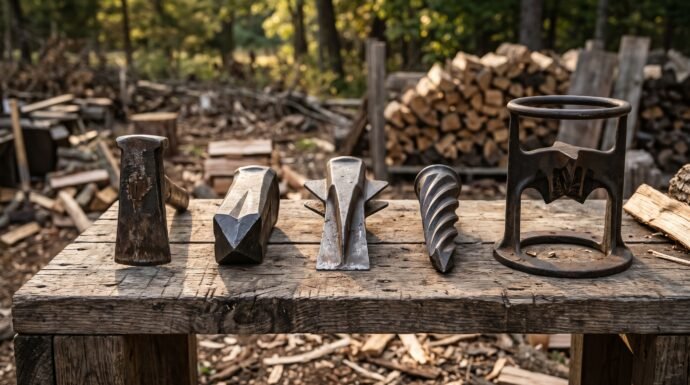
| Redneck Convent four-way | Diamond-shaped head | Listed in railway-grade steel | Smaller straight-grained rounds you want in quarters | Big knotty rounds |
| Fiskars HelixPlus | Spiral body | Check listing | Trying a shaped wedge on tough rounds | Buyers on a tight budget |
| Kindling Cracker Original | Fixed blade inside a cast-iron ring | About 16.5 cm inner ring | Kindling for a stove or fire pit | Splitting full rounds |
Best all-round wedge: Estwing Sure Split 5 lb
No products found.
The Sure Split is a solid steel wedge with a tapered head that starts easily in end grain and two side fins that push the split wider as the wedge goes in. At 5 lb it carries enough mass to keep driving through medium hardwood. It is a single forged piece, so there is no handle or insert to fail.
Drawbacks: tough, knotty rounds can still trap it, so plan on a second wedge to free it. Like any steel wedge, the striking face will mushroom over time and needs grinding back. It needs a separate sledgehammer to drive it.
Skip it if: you want to split without swinging a sledge. A hydraulic splitter is the answer there.
Best budget and second wedge: Truper Super Splitter 4 lb
No products found.
A drop-forged, heat-treated 4 lb steel wedge with a pointed nose. It does the plain job of a splitting wedge at a low price, and it is the one to keep in the wood pile as a second wedge for when the first one sticks.
Drawbacks: a plain profile means more strikes than a finned wedge on stubborn rounds. At 4 lb it is lighter than the Estwing, so it can bounce out of hard, frozen wood. The striking face needs regular dressing.
Skip it if: you want only one wedge for big hardwood. Buy the heavier Estwing first.
For quartering smaller rounds: Redneck Convent four-way diamond wedge
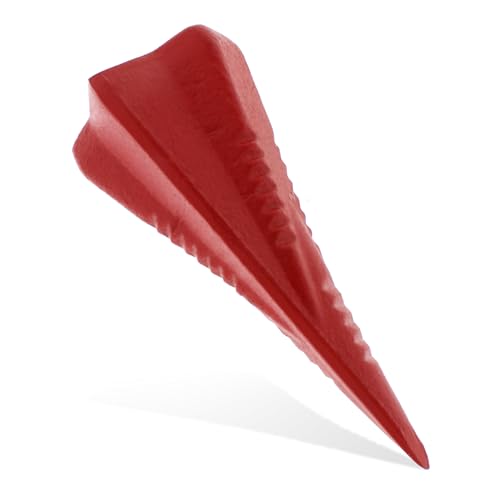
The diamond-shaped head is meant to split a round in more than one direction at once, which can save a step when quartering straight-grained, medium-size rounds. The listing describes heat-treated railway steel, a rounded striking face and side notches to help the wedge stay engaged.
Drawbacks: four clean pieces are not guaranteed; on knotty or twisted wood it often splits one way or gets stuck. Owner feedback mentions the tip deforming and burrs forming after use, so inspect it often and grind off sharp edges. The wide head needs more force to drive than a slim wedge.
Skip it if: most of your wood is large, knotty hardwood.
Shaped wedge for tough rounds: Fiskars HelixPlus


The HelixPlus uses a spiral body instead of a straight taper, so it twists the fibers apart as it is driven in. Fiskars positions it for large, difficult rounds. It is one to try if straight wedges keep sticking in your wood.
Drawbacks: it costs more than a plain wedge, and a spiral is not a guarantee against knots. Confirm weight and current specifications on the listing, as we could not verify them independently.
Skip it if: a basic steel wedge already handles your wood.
For kindling: Kindling Cracker Original
No products found.
This is not a loose wedge. It is a fixed blade inside a cast-iron ring: you stand a piece of wood in the ring and strike the top with a hammer or mallet, and the ring keeps your hands away from the blade. It is a safer way to make kindling than a hatchet.
Drawbacks: the inner ring is about 16.5 cm across, so only pieces that fit can be split. It is heavy for its size and works best bolted or set on a solid block.
Skip it if: you need to split full rounds. That still takes a wedge, maul or splitter.
How to choose a splitting wedge
- Weight: 4 to 6 lb covers most firewood. Heavier wedges carry more momentum into hard wood but take a heavier sledge to drive.
- Profile: a slim tapered tip starts easily; fins or a wider body open the split once the tip is in. Diamond and spiral shapes help on some wood but can stick on knotty rounds.
- Steel and striking face: look for forged, heat-treated steel. Every wedge mushrooms in time, so plan to grind the face.
- Two wedges, not one: a second wedge frees a stuck one far more safely than prying with an axe.
- Striking tool: drive wedges with a sledgehammer, typically 6 to 8 lb, never with the back of an axe or a claw hammer.
Splitting safely
- Wear safety glasses. Steel-on-steel strikes can throw chips.
- Start the wedge in an existing check (crack) and away from knots.
- Set the round on a solid chopping block or firm ground, not on concrete or rock.
- Tap the wedge to set it, then strike with controlled swings.
- Grind off mushroomed edges as soon as they form; they can break off and fly.
- Dry, seasoned or frozen wood usually splits more easily than fresh, green rounds.
Frequently asked questions
What weight splitting wedge should I buy?
For most firewood, a 4 to 5 lb wedge is the right range. A 5 lb wedge such as the Estwing carries more energy into hardwood and is less likely to bounce out. A lighter 4 lb wedge like the Truper is cheaper and works well as a second wedge. Pair either with a 6 to 8 lb sledgehammer.
Are four-way or spiral wedges better than a plain wedge?
Sometimes. A four-way diamond wedge can quarter straight-grained rounds in fewer strikes, and a spiral wedge can twist fibers apart on certain stubborn pieces. On knotty, twisted wood they can stick just like a plain wedge, and their wider heads take more force. Most people are best served by a good plain wedge first.
Can I hit a splitting wedge with an axe?
No. Axe heads are not made to be struck, and the eye can deform or crack, which is dangerous. Some splitting mauls have a striking face rated for driving wedges; check the maker’s instructions. Otherwise use a sledgehammer, and keep both the wedge face and the hammer face dressed so they do not chip.
What do I do when a wedge gets stuck?
Drive a second wedge into the split beside or behind the first to open the crack, which releases the stuck wedge. Do not pry it out with an axe or swing sideways at it. If the round refuses, rotate it and work along a different check, or set it aside for a hydraulic splitter.
Verdict by buyer type
- One wedge for general firewood: Estwing Sure Split 5 lb.
- Budget, or a second wedge: Truper Super Splitter 4 lb.
- Quartering medium, straight-grained rounds: Redneck Convent four-way.
- Stubborn rounds where plain wedges stick: Fiskars HelixPlus.
- Kindling for a stove: Kindling Cracker Original.
Related guides
- Best log splitters for firewood
- Best heavy-duty hydraulic log splitters
- Best axes for kindling
- Best outdoor firewood racks
Last update on 2026-11-17/Affiliate links / Images from Amazon Product Advertising API