Sew With Comfort : The 5 Best Commercial Sewing Machine Industrial (2026)
Choosing the best commercial sewing machine industrial, depends on the materials you sew, the volume of work you handle, and the controls you need. A garment tailor making shirts and trousers has different requirements from an upholsterer working with thick canvas, vinyl, or layered leather.
This comparison covers five machines: the Juki DDL-8100, VEVOR JK9808, KQZZIV Industrial Sewing Machine, Generic Sewing-machines-010, and Gbonklong Industrial Sewing Machine. The Juki is worth considering for conventional garment production, while the VEVOR offers a documented feature set that includes an LCD control panel and servo motor. The remaining models need closer specification and seller verification before their suitability can be established.
Table of Contents
At a Glance
| Product | Key Features | Ideal Use Case |
|---|---|---|
| Juki DDL-8100 | Single-needle lockstitch, automatic lubrication, knee lifter; official specifications vary by model suffix | Light- to medium-weight garment sewing |
| VEVOR JK9808 | 550W maximum motor power, LCD panel, LED light, servo motor, table and stand | Garment workshops and general sewing projects |
| KQZZIV Industrial Sewing Machine | Walking-foot feed and wide table are claimed in the supplied description; verification needed | Potential upholstery and layered-material work |
| Generic Sewing-machines-010 | LCD controls and automatic thread trimming are claimed in the supplied description; verification needed | Potential general workshop use |
| Gbonklong Industrial Sewing Machine | Cast-metal construction is claimed; the supplied description says the motor and table are excluded | Potential replacement-head installation |
Top 5 Best Commercial Sewing Machine Industrial
1. Juki DDL-8100 Sewing Machine

Overview
The Juki DDL-8100 is a single-needle industrial lockstitch machine intended for production sewing. Juki’s official documentation describes light- to medium-weight and heavy-weight versions with different operating specifications. The exact model suffix matters, so buyers should confirm which version is included in this listing.
The documented design includes an automatically lubricated rotary hook and a knee-operated presser-foot lift. These features suit repetitive garment work, where consistent stitching and convenient fabric handling matter more than specialized walking-foot feeding.
5 Key Features
- Industrial lockstitch operation: Produces conventional lockstitch seams suited to many garment construction and alteration tasks.
- Automatic lubrication: The documented DDL-8100e family uses an automatically lubricated full-rotary hook, helping lubricate an important internal mechanism.
- Knee lifter: Official specifications list a 13 mm knee-operated presser-foot lift, making it easier to reposition material without using a hand to lift the foot.
- Model-specific sewing speed: Juki documentation lists up to 4,500 stitches per minute for the DDL-8100e light- to medium-weight version and 4,000 for its heavy-weight version. Do not assume every DDL-8100 listing has the same specification.
- Defined material application: The manufacturer distinguishes versions for light-to-medium and heavy materials, making model identification important when matching the machine to a workload.
Pros
- Established industrial sewing-machine manufacturer.
- Suitable for conventional production lockstitch work when correctly matched to the material.
- Automatic lubrication on the documented DDL-8100e models.
- Knee-operated presser-foot lift supports efficient fabric handling.
Cons
- The precise version supplied by the seller needs confirmation.
- Buyers should confirm whether the table, stand, motor, and accessories are included in the specific package.
Best for: Garment makers and alteration businesses seeking a conventional industrial lockstitch machine from an established manufacturer.
2. VEVOR JK9808 Sewing Machine
Overview
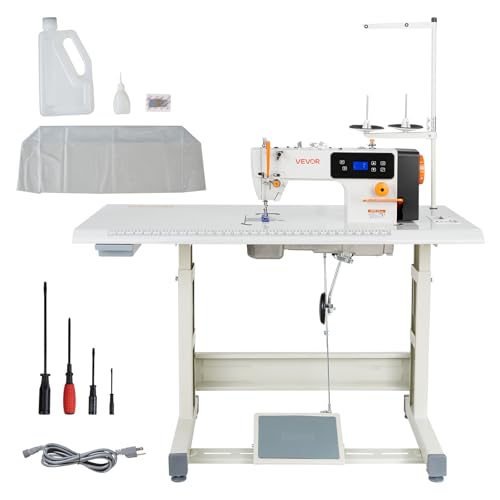
The VEVOR JK9808 is an industrial lockstitch machine with a servo motor, electronic controls, and a table-and-stand setup. VEVOR’s product information lists 550W maximum motor power, an LCD panel, an LED work light, and a knee lifter. It also specifies a maximum sewing thickness of approximately 9 mm, described as up to ten layers of denim.
These features make it worth considering for a workshop that needs adjustable operating speed and controls for positioning the needle. However, the stated maximum thickness should not be interpreted as a guarantee that every leather, canvas, or upholstery assembly can be sewn successfully.
5 Key Features
- 550W maximum motor power: The listed maximum power is useful for comparing the machine with other workshop options, although motor wattage alone does not establish needle penetration performance.
- High-speed lockstitch operation: VEVOR lists a sewing speed above 5,000 stitches per minute. Actual usable speed depends on material, setup, and operator control.
- LCD control panel: The listed controls include speed adjustment, needle positioning, and a slow-start function.
- Knee lifter and LED light: A 13 mm knee lift and built-in lighting support fabric handling and visibility around the needle.
- Table and stand package: The product information lists an approximately 1,200 × 535 mm table with adjustable height, providing space for handling larger garment pieces and panels.
Pros
- Electronic speed and needle-position controls.
- Servo motor included in the documented machine setup.
- Built-in LED work light.
- Table and stand are included in the advertised set, subject to confirmation of the exact package.
Cons
- Assembly is required, and the head and table may arrive separately.
- Maximum sewing thickness does not guarantee compatibility with every heavy material or multilayer seam.
Best for: Small commercial workshops that want electronic controls and a complete table-based setup for general lockstitch work.
3. KQZZIV Industrial Sewing Machine
Overview
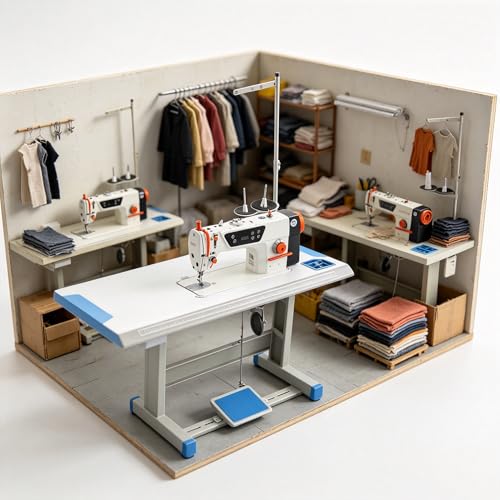
The supplied product description presents the KQZZIV as a heavy-material machine with a walking-foot feed system, a wide table, and electronic controls. Those features would be relevant to upholstery and other work where multiple layers need to move together. However, I could not independently verify the exact model’s specifications from a reliable manufacturer source.
Treat the description as a starting point rather than proof of capability. Confirm that the delivered machine genuinely has a walking foot, determine its needle and thread compatibility, and establish whether it is suitable for your intended material thickness.
5 Key Features
- Walking-foot feed — claimed: A genuine walking-foot mechanism helps feed multiple layers together and can reduce shifting between layers.
- 550W servo motor — claimed: The supplied description lists this motor rating; verify the actual motor and its rated power.
- Speed up to 5,000 stitches per minute — claimed: Confirm the manufacturer’s rated speed for the exact machine.
- Wide worktable — claimed: The description specifies a table approximately 47 inches wide, potentially useful for larger panels.
- LCD controls — claimed: The description mentions electronic speed and needle-position settings; confirm which functions are actually included.
Pros
- The claimed walking-foot feed could suit layered upholstery materials.
- The described wide table could support larger workpieces.
- The claimed servo motor may offer adjustable operating speed.
- Electronic controls could be useful if confirmed on the delivered model.
Cons
- The walking-foot mechanism and performance specifications have not been independently verified.
- Confirm the complete package, technical documentation, spare-parts availability, and warranty before purchasing.
Best for: Buyers specifically seeking a walking-foot machine who can verify the exact model and its capabilities before ordering.
4. Generic Sewing-machines-010

Overview
The supplied description presents the Generic Sewing-machines-010 as a general-purpose industrial sewing setup with electronic controls, automatic thread trimming, and a large worktable. Those features could make a machine convenient for repetitive workshop tasks, but the exact model and the stated features have not been independently verified.
Before comparing this option with established industrial models, ask the seller for the manufacturer name, model plate, operating manual, and a complete specification sheet. These details are particularly important when buying a machine intended for daily commercial use.
5 Key Features
- 550W servo motor — claimed: The supplied description lists this rating, which should be checked against the actual motor label.
- High-speed sewing — claimed: A maximum of 5,000 stitches per minute is stated in the supplied material, but requires verification.
- LCD touchscreen — claimed: The description mentions electronic speed and needle-position controls.
- Automatic thread trimmer — claimed: Confirm whether the delivered model includes an integrated trimmer and whether additional installation is necessary.
- Large worktable — claimed: The supplied description refers to a table approximately 47 inches wide; verify its dimensions and whether it comes with the machine.
Pros
- The advertised electronic controls could simplify adjustments during repetitive sewing.
- An integrated thread trimmer, if confirmed, could reduce manual trimming.
- A large table could be helpful for handling bigger fabric pieces.
- A servo motor, if included as described, could provide adjustable speed control.
Cons
- Manufacturer identity and detailed technical specifications need confirmation.
- Confirm the warranty, service arrangements, spare parts, and full package contents before relying on it for business production.
Best for: Buyers evaluating a feature-rich industrial setup who can obtain reliable documentation and seller support before committing.
5. Gbonklong Industrial Sewing Machine

Overview
The supplied description presents the Gbonklong as a commercial sewing-machine head for vinyl, upholstery, and synthetic materials. It also states that the package excludes the table, stand, and separate motor unit.
That distinction is important: a machine head alone is not a complete sewing station. Buyers who already own a compatible industrial table and drive system may find a replacement head worth investigating, but those starting from scratch need to calculate the cost of the additional equipment.
5 Key Features
- Metal construction — claimed: The supplied description identifies cast-metal construction. Confirm the actual materials and build specifications with the seller.
- Motor configuration — requires verification: The description mentions a copper motor but also states that the motor unit is excluded. Clarify exactly what is included before ordering.
- Stitch-length adjustment — claimed: The description states that stitch length can be adjusted up to approximately 5 mm.
- Reverse stitching — claimed: A one-touch reverse lever is described; confirm its presence and operation on the exact model.
- Machine-head-only package — stated in supplied material: The description says the table, stand, and separate motor are not included. Verify the current listing and package contents.
Pros
- A replacement head may be useful when a compatible industrial workstation is already available.
- The described adjustable stitch length could support different seam requirements.
- Reverse stitching, if confirmed, can help secure seam ends.
- Buying a head separately may avoid duplicating existing workshop equipment.
Cons
- A separate compatible motor and table setup may be needed.
- Voltage, drive compatibility, supported materials, and the precise included components must be confirmed.
Best for: Experienced workshop owners replacing a machine head or building around existing compatible equipment.
Final Verdict
There is no single best commercial industrial sewing machine for every business. The right choice depends on the type of stitching, material thickness, production volume, and whether you need a complete workstation or only a machine head.
- For conventional garment sewing: Consider the Juki DDL-8100, after confirming the exact model suffix and material rating.
- For electronic controls and a table-based setup: The VEVOR JK9808 has the clearest documented feature set among the five options.
- For upholstery and layered materials: Investigate the KQZZIV only after verifying its walking-foot mechanism and specifications.
- For a feature-rich workshop machine: Request complete technical documentation for the Generic Sewing-machines-010 before comparing its value.
- For an existing industrial workstation: The Gbonklong may be worth investigating as a replacement head, provided the required motor and table arrangements are compatible.
Before purchasing any industrial machine, confirm its stitch type, material rating, needle system, compatible thread, motor specifications, included accessories, electrical requirements, and access to servicing.
Best For Table
| Buyer Type / Scenario | Recommended Option | Why |
|---|---|---|
| Conventional garment production | Juki DDL-8100 | Established lockstitch design with documented light- to medium-weight and heavy-weight variants |
| Electronic controls and complete workstation | VEVOR JK9808 | Documented LCD panel, servo motor, lighting, table, and stand |
| Upholstery and multilayer sewing | KQZZIV, subject to verification | The supplied description claims a walking-foot feed |
| Automatic trimming and electronic controls | Generic Sewing-machines-010, subject to verification | The supplied description claims an LCD touchscreen and automatic thread trimmer |
| Replacement machine head | Gbonklong, subject to verification | The supplied description says the head is sold without a table, stand, or separate motor |
FAQs
1. What is the best commercial industrial sewing machine for a tailoring business?
For ordinary garment production, start by evaluating a conventional industrial lockstitch machine such as the Juki DDL-8100. Confirm the exact version is suitable for the fabric weights you sew and that the package includes the equipment you need.
2. Is a higher stitches-per-minute rating always better?
No. Maximum speed matters in repetitive production, but stitch quality, feed consistency, motor control, operator skill, and material compatibility are equally important. A machine that runs more slowly but handles the material reliably may be more useful for detailed work.
3. Can an industrial lockstitch machine sew leather and upholstery?
Some industrial lockstitch models can handle selected leather or upholstery applications, but not every lockstitch machine is designed for heavy materials. Check the model’s intended material range, needle system, thread capacity, and feeding mechanism before buying.
4. What is the advantage of a walking-foot sewing machine?
A walking-foot mechanism helps move the upper and lower layers together. This can reduce shifting and uneven feeding when sewing multilayer upholstery, vinyl, canvas, and similar materials. Confirm that the machine actually uses a walking-foot system.
5. Should I buy a machine head only or a complete sewing setup?
A machine head may make sense if you already have a compatible industrial table, motor, belt or drive system, and controls. New workshop owners generally need to compare the total cost of a complete setup, including installation and accessories.
6. What should I check before buying an industrial sewing machine online?
Check the exact model number, supported materials, maximum stitch length, needle system, motor rating, voltage, package contents, warranty, service availability, and return policy. For lesser-known brands, request the manual and a demonstration of the machine sewing your intended material.
Last update on 2026-10-24/Affiliate links / Images from Amazon Product Advertising API