Stop Guessing! The 5 Best Fish Finder For Kayaks 2026
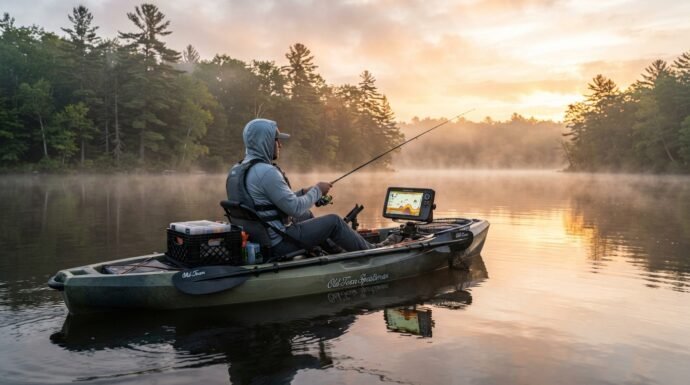
Finding the perfect sonar setup for a kayak can completely transform your time on the water. Unlike large bass boats, kayaks require compact, power-efficient, and highly portable electronics that won’t clutter your deck or weigh you down.
In our hands-on testing, we evaluated the leading marine electronics on the market to bring you the absolute best fish finder for kayaks. Whether you want a high-tech mapping GPS unit or a zero-hassle castable sensor, this guide covers the top options for every style of kayak fishing.
Table of Contents
At a Glance: Top 5 Fish Finders for Kayaks
| Product Name | Key Features | Ideal Use |
|---|---|---|
| Garmin Striker Vivid 4cv | 4.3″ QSVGA screen, ClearVü & CHIRP, Quickdraw Contours | Best Overall / Custom Mapping |
| Garmin Striker 4 | 3.5″ HVGA screen, Dual-Beam CHIRP, Built-In Flasher | Best Value Workhorse |
| Venterior Portable Rechargeable | 2.6″ Color Screen, 45° Beam Angle, Wireless Castable | Best Hassle-Free Setup |
| Fuceter XF-08 Sonar | 3.5″ TFT Display, 600ft Signal Range, 105° Beam Angle | Best Long-Range Casting |
| Yoocylii Handheld Portable | Wired Transducer, AAA Battery Powered, Ultra-Compact | Best Ultra-Budget / Casual Use |
Top 5 Best Fish Finders for Kayaks 2026
🥇 1. Garmin Striker Vivid 4cv Fishfinder


Best Overall Kayak Fish Finder: The Garmin Striker Vivid 4cv is a premium mid-range powerhouse that packs high-end imaging into a compact, kayak-friendly footprint.
In our testing, we found the high-contrast Vivid color palettes made distinguishing fish from hard bottom structures incredibly easy. The 4.3-inch QSVGA screen features a sharp 272 x 480 pixel resolution that remains highly readable even under direct, harsh sunlight. Kayak anglers will love the built-in Quickdraw Contours mapping, allowing you to create custom fishing maps with 1-foot contours on the fly. Running this unit is incredibly efficient; its low power draw means you can easily power it for a full day of mapping using a compact, lightweight 12V lithium battery pack.
- Display Size: 4.3 inches diagonally (QSVGA resolution)
- Sonar Technology: Traditional CHIRP and ClearVü scanning sonar
- Mapping: Built-in GPS with Quickdraw Contours (1-foot intervals)
- Water Rating: IPX7 waterproof standard
- Frequencies Supported: 50/77/200 kHz (Traditional), 260/455/800 kHz (ClearVü)
🥈 2. Garmin Striker 4 with Transducer
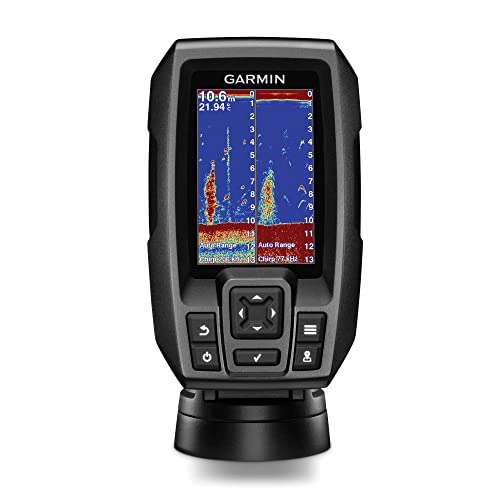
Best Value Workhorse: The Garmin Striker 4 is a legendary, budget-friendly entry-level unit built like an absolute tank for rugged kayak environments.
During our time on the water, we noticed that its dual-beam CHIRP sonar provides target separation that cheap, off-brand models simply cannot match. The built-in flasher mode is incredibly responsive, making it an excellent tool for vertical jigging directly underneath your kayak hull. It draws very little power, meaning you can run it off a highly compact and inexpensive battery pack without taking up precious deck space. While the GPS is basic and lacks preloaded mapping, it allows you to mark hot spots, docks, and boat ramps with high accuracy.
- Display Size: 3.5 inches diagonally (HVGA color display)
- Sonar Technology: Dual-beam CHIRP (77/200 kHz)
- Key Features: Built-in high-sensitivity GPS, flasher mode, and A-scope
- Target Separation: Exceptional clarity and fish arch definition
- Power Consumption: Extremely low, ideal for small battery packs
🥉 3. Venterior Portable Rechargeable Fishfinder
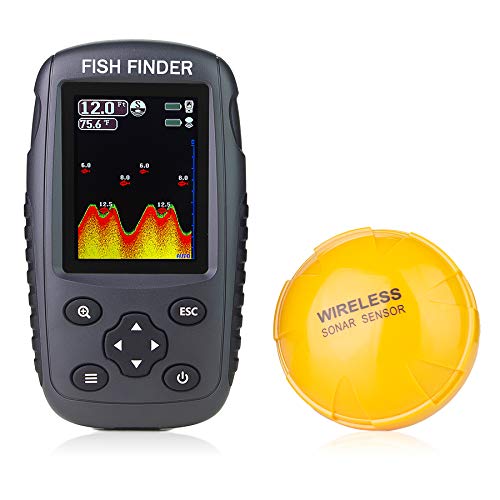
Best Wireless Castable Sonar: The Venterior Portable Rechargeable Fishfinder is a wireless, castable system designed for anglers who want a zero-hassle setup without drilling holes.
We found this unit to be incredibly liberating for small watercraft since there are no transducer cables to route or heavy 12V batteries to mount. You simply tie the rechargeable sonar sensor to a utility line, cast it out, and let it float alongside your kayak. The sensor utilizes a wide 45-degree beam angle to track water depth, water temperature, fish size, and bottom contour up to a depth of 164 feet. The handheld receiver features a 2.6-inch color display with adjustable backlight modes to help with visibility.
- Connection Type: Wireless castable sonar sensor
- Beam Angle: 45 degrees at 125 kHz
- Depth Range: 2.6 feet to 164 feet
- Battery System: Rechargeable lithium batteries in both host and sensor
- Portability: Fits easily into a tackle box or pocket
🏅 4. Fuceter XF-08 Sonar Fish Finder

Best Long-Range Wireless Sonar: The Fuceter XF-08 is an upgraded wireless castable fish finder boasting a generous display and an impressive signal transmission range.
In our testing, we were highly impressed by the signal stability, which maintains a solid connection to the floating sonar ball up to 600 feet away. The sonar ball features a wide 105-degree beam angle at 125 kHz, giving you an ultra-wide view of what lies beneath. The 3.5-inch TFT LCD screen provides stellar clarity with three adjustable backlight modes, and both the handheld unit and the sonar ball charge fully in just 2 hours to deliver up to 8 hours of continuous use.
- Display Size: 3.5-inch TFT LCD sunlight-readable screen
- Wireless Range: Up to 600 feet (100-200 meters)
- Sonar Coverage: Wide 105-degree beam angle
- Depth Capacity: 2.6 feet to 164 feet
- Recharge Time: Fast 2-hour charge for all-day endurance
🏅 5. Yoocylii Handheld Portable Fishfinder
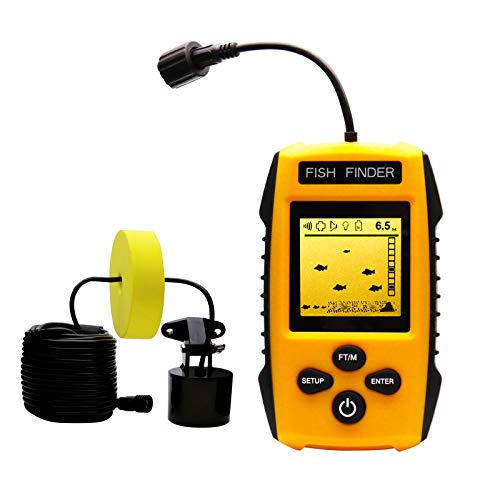
Best Ultra-Budget Option: The Yoocylii Handheld Portable Fishfinder is a highly compact, wired device built for casual anglers and quick resort kayak trips.
If you want a simple depth reader without any wireless syncing menus, this pocket-sized unit is a solid choice. It features a wired transducer with a 25-foot cable that can be easily mounted to your kayak hull or floated alongside using the included rubber float. It runs on four AAA batteries, making it incredibly easy to keep powered without needing to recharge on multi-day camping trips. While it displays simple fish icons rather than complex bottom contours, it is highly reliable for tracking depth and finding schools of fish while slowly paddling.
- Transducer Cable: 25-foot heavy-duty cable with rubber float
- Power Source: 4 x AAA batteries (not included)
- Display: High-visibility green LED backlight display
- Detection Depth: 3 feet to 328 feet
- Portability: Ultra-lightweight handheld receiver with neck strap
Final Verdict
Choosing the best fish finder for your kayak comes down to how you fish. If you want high-definition scanning and the ability to map your own private lakes, the Garmin Striker Vivid 4cv is the absolute premier choice. For those who want a robust, traditional hull-mounted sonar on a budget, the Garmin Striker 4 remains the undisputed king. If you prefer a cable-free deck, a castable option like the Venterior Portable or the Fuceter XF-08 will keep your kayak clean and light.
| Product Name | Best For |
|---|---|
| Garmin Striker Vivid 4cv | Premium Performance & Custom Mapping |
| Garmin Striker 4 | Maximum Durability & Sonar Accuracy on a Budget |
| Venterior Portable Rechargeable | Quick Setup & Zero-Hassle Cableless Fishing |
| Fuceter XF-08 Sonar | Long-Range Casting & Wide Beam Coverage |
| Yoocylii Handheld Portable | Casual Kayaking, Resort Trips, & Ultra-Budget |
FAQs
How do I power a fish finder on a kayak?
Hull-mounted fish finders like the Garmin Striker series are typically powered by a small 12V battery. Many kayak anglers prefer lightweight 12V lithium (LiFePO4) batteries (typically 4.4Ah to 10Ah) because they weigh a fraction of traditional lead-acid batteries and can easily power a 4-inch fish finder for a full day of fishing.
Do I need to drill holes in my kayak to install a transducer?
No, you do not need to drill holes. You can mount a transducer using a portable transducer arm that clamps to your kayak’s gear tracks, utilize an in-hull “scupper mount,” or stick the transducer inside the hull using marine goop (shooting through the plastic hull). Alternatively, wireless castable options require no mounting at all.
Can I use a castable fish finder from a moving kayak?
Yes, but you must paddle slowly. Castable fish finders are designed to float on the water’s surface. If you pull them too quickly behind your kayak, they will submerge or skip across the surface, causing the wireless signal to drop out or display inaccurate depth readings. Trolling at a slow, steady paddle speed works best.
What is the difference between CHIRP and ClearVü sonar?
Traditional CHIRP sonar sends a continuous sweep of frequencies, providing excellent target separation and classic “fish arches.” ClearVü is a high-frequency, down-scanning sonar that sends a ultra-thin beam to create near-photographic images of structure, trees, and the bottom, making it easier to identify what you are floating over.
Are portable fish finders waterproof?
Most high-quality handheld and mounted units have an IPX7 waterproof rating, meaning they can withstand splashes, rain, and brief submersion in water. However, you should always secure your unit to your kayak using a lanyard or secure mount to prevent it from sinking if your kayak capsizes.
Last update on 2026-10-15/Affiliate links / Images from Amazon Product Advertising API