Best Home Theater Systems for Every Budget: 5 Picks
Short answer: of these home theater systems for every budget, our top pick is the ULTIMEA Poseidon M60. It is the cheapest system here, yet it includes a sound bar and a wired subwoofer, supports Dolby Atmos over HDMI eARC, and uses side-firing drivers to widen the sound. If you want real surround speakers, pick the Yamaha; for a full wireless setup, the Samsung HW-Q990F.
Table of Contents
- How we chose
- Quick comparison
- 1. ULTIMEA Poseidon M60 5.1 Sound Bar
- 2. Yamaha YHT-4970U 5.1 Home Theater System
- 3. Bose Smart Ultra Soundbar
- 4. Sonos Arc Ultra
- 5. Samsung HW-Q990F 11.1.4 Soundbar
- How to choose home theater systems for every budget
- Mistakes to avoid
- FAQ
- Verdict by buyer type
- Related guides
How we chose
These five picks and the opinions about them come from our own video review of the lineup. Specs, features and box contents are taken from manufacturer information and the Amazon listings. We did not measure sound output or frequency response ourselves, so every number here is a listed figure. You can check the full specs on the official Yamaha, Bose, Sonos and Samsung sites. Prices were checked when the video was made and change often.
Quick comparison
| System | Best for | Channels (listed) | Subwoofer | Rear speakers |
|---|---|---|---|---|
| ULTIMEA Poseidon M60 | Budget | 5.1 | Yes, wired | No |
| Yamaha YHT-4970U | Traditional surround | 5.1 | Yes, powered | Yes, wired |
| Bose Smart Ultra Soundbar | Single-bar setup | Bar only | No | No |
| Sonos Arc Ultra | Smart, expandable | 9.1.4 (Sonos claim) | Optional add-on | Optional add-on |
| Samsung HW-Q990F | Complete surround | 11.1.4 | Yes | Yes |
1. ULTIMEA Poseidon M60 5.1 Sound Bar

Who it is for: bedrooms, apartments and anyone who wants clearer dialogue and more bass than TV speakers on a small budget.
Key facts: a 5.1-channel system with Dolby Atmos support, five built-in speakers including two side-firing drivers, and a wired wooden subwoofer. It is rated at up to 300 watts of peak power with a listed frequency response of 45 Hz to 18 kHz. VoiceMX is designed to bring dialogue forward at low volume, and BassMX tuning targets the subwoofer. HDMI eARC passes the full Dolby Atmos signal from your TV, and ULTIMEA says setup takes under a minute.
Drawbacks: the subwoofer is wired, so you need to plan the cable route. With no rear speakers and no up-firing drivers listed, surround and height effects have clear limits. Peak power figures are not the same as continuous power.
Skip it if: you want sound coming from behind you or above you, or you are setting up a large living room.
2. Yamaha YHT-4970U 5.1 Home Theater System
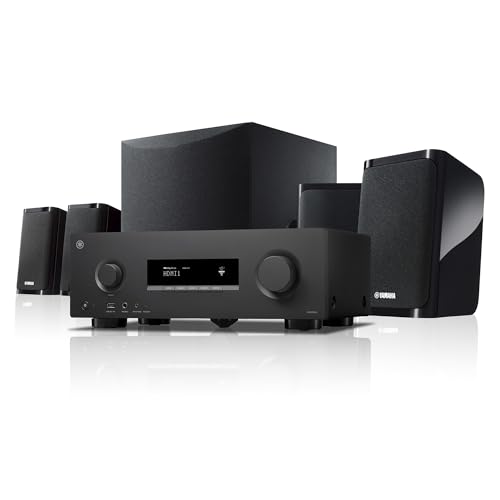
Who it is for: people who want a real receiver-and-speaker system they can upgrade one piece at a time.
Key facts: the box includes a Yamaha RX300A AV receiver, two front speakers, a center channel, two surround speakers, a powered subwoofer and speaker wire. The receiver supports Dolby Atmos and DTS Virtual:X, 4K at 120Hz and 8K at 60Hz video, Dolby Vision, HDR10+, and gaming features ALLM and VRR. An included setup microphone measures your room and tunes the sound automatically. Bluetooth Multipoint lets two devices stay paired.
Drawbacks: setup takes the most work here, with speaker wire running to five speakers. There are no height speakers in the box, so Atmos height effects are not physical. It also takes more room than any sound bar.
Skip it if: you rent and cannot run wires, or you want a single box under the TV.
3. Bose Smart Ultra Soundbar
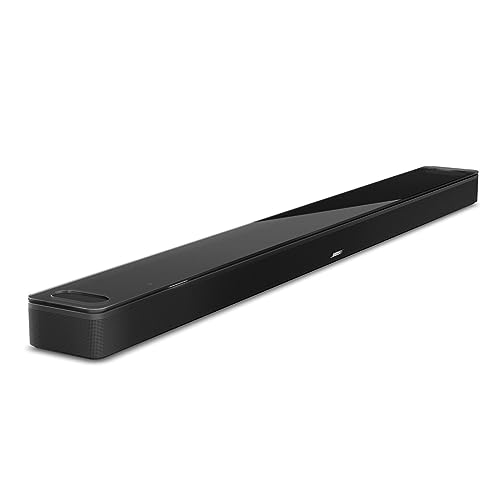

Who it is for: people who want one clean bar with smart features and strong dialogue clarity.
Key facts: six transducers, including two custom up-firing dipole speakers for overhead sound. Bose TrueSpace spreads sound around the room, and A.I. Dialogue Mode balances voices against effects. Amazon Alexa is built in, with control by remote or app. Bose includes both an optical cable and an HDMI eARC cable. SimpleSync pairs it with select Bose headphones for private listening.
Drawbacks: this listing has no subwoofer or rear speakers, so bass and surround will not match a full system. Adding Bose’s own sub or rears raises the total cost a lot.
Skip it if: deep bass for action movies is your priority and you do not plan to buy a subwoofer.
4. Sonos Arc Ultra

Who it is for: Sonos owners and anyone who wants to start with a bar and grow into a full Atmos system later.
Key facts: Sonos describes it as a 9.1.4 spatial audio experience with Dolby Atmos, using Sound Motion technology. Speech Enhancement uses AI to clarify dialogue, and Trueplay tunes the sound to your room. You can control it with your TV remote, the Sonos app, touch controls, Sonos Voice Control or Amazon Alexa. It streams over Wi-Fi, Bluetooth, AirPlay 2 and Spotify Connect. Setup is one HDMI eARC cable to the TV, and you can add a Sonos Sub and Era 300 rear speakers later.
Drawbacks: this listing is the bar alone, and the Sub and rear speakers cost extra. It has a single HDMI connection, so all your devices must plug into the TV. Setup and many features depend on the Sonos app.
Skip it if: you want a complete system in one purchase, or you prefer not to rely on an app.
5. Samsung HW-Q990F 11.1.4 Soundbar

Who it is for: people who want a complete surround package with a Samsung TV, in one box.
Key facts: an 11.1.4-channel system with the sound bar, a subwoofer and rear speakers, plus wireless Dolby Atmos to cut cable clutter. Q-Symphony lets a Samsung TV and the bar play together, and SpaceFit Sound Pro uses the bar’s microphone to calibrate for your room. This listing is a bundle sold by Walt’s TV that adds five years of Amber protection on top of the one-year manufacturer warranty, plus a screen cleaner kit.
Drawbacks: it is the most expensive pick. Q-Symphony and wireless Atmos work best with a Samsung TV. The rear speakers and sub still need power outlets, and the extended warranty comes from a third-party seller, not Samsung.
Skip it if: you own a non-Samsung TV and would not use its TV-pairing features, or your room is small.
How to choose home theater systems for every budget
- Check for HDMI eARC. Lossless Dolby Atmos from TV apps needs eARC on both the TV and the bar or receiver. Plain ARC or optical carries less.
- Match the room. A single bar suits small rooms and bedrooms. In a larger living room, a separate subwoofer and rear speakers make a bigger difference than extra bar drivers.
- Look at bass range. A listed low end of around 45 Hz or lower is a sign of real subwoofer output. Bars without a sub rarely reach that.
- Plan power and wires. “Wireless” rear speakers and subs still need an outlet. Receiver systems need speaker wire to every speaker.
- Ceiling for up-firing drivers. Up-firing Atmos speakers bounce sound off the ceiling, so they work best with a flat, standard-height ceiling.
Mistakes to avoid
- Connecting through optical or plain ARC and then wondering why Atmos is missing.
- Putting the subwoofer in a cabinet or tight corner without testing other spots.
- Skipping the room calibration step on systems that include it.
- Buying a bar much wider or taller than the TV stand, or one that blocks the TV’s IR sensor.
- Comparing peak watt ratings across brands as if they were the same measurement.
FAQ
Is a sound bar or a 5.1 receiver system better?
A receiver system like the Yamaha gives real separate speakers and is easier to upgrade one piece at a time, but it takes more setup and wiring. A sound bar is simpler and tidier. For a small room or a renter, a bar usually makes more sense. For a dedicated movie room, a receiver does.
Do I need rear speakers for surround sound?
For true surround, yes. Side-firing and up-firing drivers can widen and lift the sound, but they cannot fully place effects behind you. If you want that effect, choose the Yamaha or Samsung systems, or plan to add rear speakers to the Sonos Arc Ultra later.
Will the Samsung HW-Q990F work with a non-Samsung TV?
Yes, it connects to other TVs through HDMI eARC like any sound bar. You lose Samsung-only features such as Q-Symphony, where the TV speakers play along with the bar, and wireless Dolby Atmos from the TV. If you own another brand, compare it against the Sonos and Bose first.
What is HDMI eARC and why does it matter?
eARC is an HDMI feature that sends high-quality audio from your TV back to the sound bar or receiver. It can carry lossless Dolby Atmos from TV apps and connected devices. Without it, you are limited to compressed audio. Use the HDMI port labeled eARC on both the TV and the audio system.
Verdict by buyer type
Here is how these home theater systems for every budget line up, depending on your room and setup:
- Small budget or bedroom: ULTIMEA Poseidon M60.
- Real receiver and speaker system: Yamaha YHT-4970U.
- One bar, no extras: Bose Smart Ultra Soundbar.
- Smart and expandable later: Sonos Arc Ultra.
- Complete surround with a Samsung TV: Samsung HW-Q990F.
Related guides
- Best high-end soundbars with Dolby Atmos
- Best AV receivers for home cinema
- Best home theater systems for small rooms
- Best 85-inch TVs for home theater
- Best 4K home theater projectors
Last update on 2026-11-14/Affiliate links / Images from Amazon Product Advertising API