4 Best Apple Presses for Cider Making (2026)
Short answer: for a backyard tree or two, the EJWOX 4.75 gallon wooden press is the pick from this group: a traditional screw basket press with enough room for a useful batch and a spout that drains straight into a bucket. If you press several bushels every fall, the Mosakar hydraulic press holds about 40 liters and has stainless steel juice-contact parts, which is worth the extra cost. Either way, you need to crush or grind the apples first.
How we chose
We have not pressed cider with these presses ourselves. The picks are based on manufacturer specifications, product listings and owner feedback, compared against what a cider press has to do: hold enough crushed fruit for your harvest, apply enough pressure to get a good yield, keep juice in contact only with food-safe surfaces, and come apart easily for cleaning between batches. Check the current listing before you buy, since capacities and included parts vary.
Quick comparison
| Press | Type | Capacity (listed) | Best for | Not for |
|---|---|---|---|---|
| EJWOX 4.75 gal | Manual screw, wooden basket | 4.75 gal basket | Home cider from a few trees | Pressing many bushels in a day |
| Mosakar hydraulic | 5-ton hydraulic jack | 40 L (10.6 gal), 304 stainless contact parts | Large harvests, regular pressing | Small batches or tight spaces |
| Festisoul 2.38 gal | Manual screw, stainless basket | 2.38 gal | Small batches, easy cleaning | Full-tree harvests |
| SQUEEZE master 6 L | Manual screw, wooden basket | About 1.6 gal, 6 to 8 lb fruit | Trying cider for the first time | Anything past a small batch |
Best for most home cider makers: EJWOX 4.75 gallon press

This is a classic basket press: slatted hardwood basket, a screw and handle, and a base with a spout that directs juice to a container. At 4.75 gallons it takes a reasonable load of pulp per pressing, and the basket separates so the pressed cake comes out easily between batches. It needs no power.
Drawbacks: the maker states apples must be crushed before loading, so you need a separate fruit crusher or grinder. Turning the screw takes real effort on a full basket. Wooden slats need careful drying after each session to avoid mold.
Skip it if: you have only a handful of apples, or you plan to press several bushels in one day.
Best for big harvests: Mosakar hydraulic fruit press
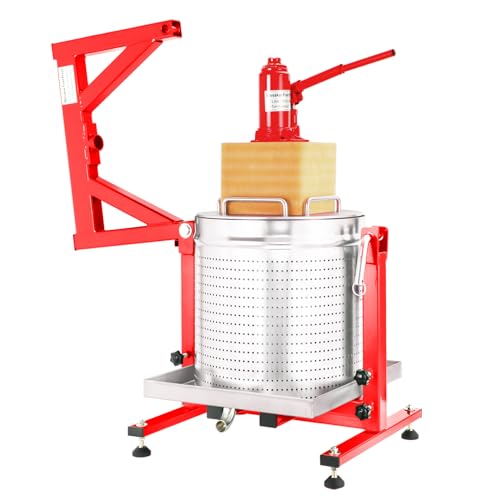
The Mosakar swaps screw turning for a hydraulic jack rated by the maker at five tons, so you pump instead of crank. Its 40-liter basket, pressing plate and juice tray are listed as AISI 304 stainless steel, which stands up to acidic juice and is easy to sanitize. An adjustable tray height and pivoting crossbeam make loading and collecting simpler.
Drawbacks: it is large and heavy and needs a sturdy floor or bench. A hydraulic jack is one more part to maintain and can leak if stored badly. It is overkill if you press only a few gallons a year.
Skip it if: you have fewer than a couple of trees, or no dedicated space to store it.
Compact with a stainless basket: Festisoul 2.38 gallon press

The Festisoul is a smaller screw press with a stainless steel basket, a cast iron base with stabilizing legs and a crossbeam that swings aside for loading. The stainless basket is easier to keep clean than wood. The listing says it arrives fully assembled.
Drawbacks: 2.38 gallons is small, so you will press in many rounds. The cast iron base is heavy for its size. Details come mostly from the seller description, so confirm included accessories such as press bags before ordering.
Skip it if: you have a full tree or more to press.
For small trial batches: SQUEEZE master 6 L press
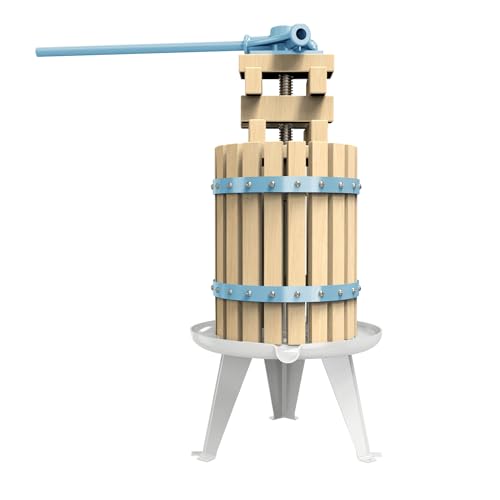
With a roughly 1.6-gallon (6-liter) basket and a listed load of 6 to 8 pounds of fruit, this is a small press for testing cider making or pressing grapes and berries. An extended handle and spiral mechanism are meant to improve leverage.
Drawbacks: 6 to 8 pounds of apples yields well under a gallon of juice per load, so it is slow for any real harvest. The wooden basket needs the same drying care as larger wooden presses.
Skip it if: you already know you enjoy cider making. The EJWOX is a better long-term buy.
How to choose an apple press
- Size to your harvest: a common rule of thumb is 15 to 20 pounds of apples per gallon of cider, depending on variety and how finely they are ground. A bushel (about 40 lb) gives roughly 2 to 3 gallons.
- Screw or hydraulic: screw presses are simpler and cheaper; hydraulic presses apply more force with less effort and suit larger, frequent batches.
- Food-contact materials: stainless steel and food-grade hardwood are the usual choices. Avoid bare or painted metal touching juice.
- Crusher: whole apples do not press well. Budget for a fruit crusher or grinder if the press does not include one.
- Press bags: mesh press bags keep pulp in and juice clearer, and make clean-up much faster.
Making cider: mistakes to avoid
- Pressing whole or coarsely chopped apples. Grind to a coarse pulp first for a far better yield.
- Pressing too fast. Apply pressure in stages and let the juice run between turns or pumps.
- Using damaged or dirty fruit without washing and trimming it. Bruised spots are fine; rotten fruit and soil are not.
- Skipping heat treatment for fresh cider you will share or store. University extension services commonly advise heating fresh cider to at least 160°F to kill pathogens; otherwise keep it cold and drink it within a few days.
- Leaving a wooden basket wet. Rinse, scrub and dry it fully before storage.
Frequently asked questions
How many apples do I need for a gallon of cider?
Plan on roughly 15 to 20 pounds of apples per gallon, or about a third to half of a bushel. Juicy varieties, ripe fruit and a fine grind push yield toward the better end. Hard, under-ripe apples and coarse chopping push it the other way. Small presses mean more rounds, not a lower yield per pound.
Do I need a fruit crusher as well as a press?
Yes, for apples. A press squeezes juice out of pulp; it cannot break down whole apples. The EJWOX maker states fruit must be crushed first, and the same applies to the others. Small batches can be pulped with a food processor, but a dedicated crusher or grinder is far faster for a real harvest.
Is a hydraulic press worth it for home cider?
It is worth it if you press several bushels a year or find screw turning hard on your hands and wrists. A hydraulic jack applies more force with less effort and often gives a drier pomace. For a single tree or occasional batches, a good screw press does the job for less money and with less to maintain.
Is wood or stainless steel better for a cider press basket?
Both work. Hardwood is traditional and fine if it is food-grade and dried thoroughly after each use, but it can harbor mold if stored damp. Stainless steel is easier to sanitize and does not absorb juice, which is why larger and more modern presses, like the Mosakar and Festisoul, use it for contact parts.
Verdict by buyer type
- A few backyard trees: EJWOX 4.75 gallon.
- Orchard or several bushels each fall: Mosakar hydraulic.
- Small batches, prefer stainless steel: Festisoul 2.38 gallon.
- Just trying cider making: SQUEEZE master 6 L.
Related guides
- Best cold press juicers
- Best honey extractors for beekeepers
- Best greenhouse kits for backyard farming
- Best utility wagons for farm hauling
Last update on 2026-11-20/Affiliate links / Images from Amazon Product Advertising API