
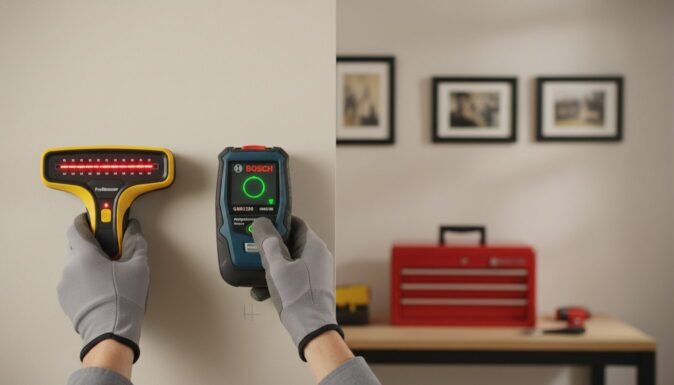
Don’t Drill Blind: The Best Stud Finder for Drywall
Finding a stud shouldn’t feel like a guessing game that leaves your walls looking like Swiss cheese. Whether you are hanging a heavy TV or a simple gallery wall, the right tool makes the job effortless. In our testing, we found that modern sensors have evolved to be faster, deeper, and much more accurate than the old-school beep-only models.
In 2026, the best stud finder for drywall combines multi-sensor technology with safety features like live wire detection. We’ve analyzed the top performers on the market, focusing on ease of use, detection depth, and reliability. These picks ensure you hit the center of the stud every single time without the frustration of “ghost” readings.
Table of Contents
At a Glance: Top 5 Best Stud Finders for Drywall
| Product Name | Key Features | Ideal Use |
|---|---|---|
| Franklin ProSensor T13 | 13 Sensors, No Calibration | Speed & Ease |
| Bosch GMS120 | 4.75″ Depth, Multi-Material | Professional Reno |
| Franklin ProSensor M210 | Live Wire Alert, 13 Sensors | Safe DIY Projects |
| Klein Tools ESF150LL | Dual Laser Lines, Layout Tool | Gallery Walls |
| The StudBuddy | Magnetic, No Batteries | Simple Utility |
Top 5 Best Stud Finders for Drywall 2026
🥇 1. Franklin Sensors ProSensor T13
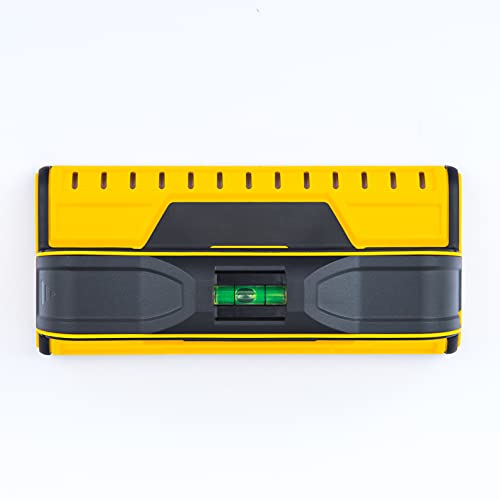
The ultimate choice for speed and accuracy in modern homes. In our testing, the T13 stood out because it doesn’t require the tedious side-to-side calibration dance that ruins many other scanners. You simply press the button against the wall, and the 13 internal sensors instantly map out the stud’s location.
- 13-Sensor Array: Identifies the center and edges of studs simultaneously.
- One-Step Operation: No calibration needed; just press the button and go.
- Wide Display: Large LED interface shows the full width of the stud.
- Deep Detection: Accurately scans through drywall up to 1.7 inches thick.
- Versatile Design: Handles both wood and metal studs without manual mode switching.
🥈 2. Bosch GMS120 Digital Multi-Scanner

The heavy-duty pick for those who need to see deep behind the surface. We noticed that the Bosch GMS120 is less of a simple stud finder and more of a multi-material radar. It is particularly effective for finding steel studs or copper pipes buried deep in walls or even cured concrete.
- Multi-Mode Detection: Scans for wood, ferrous/non-ferrous metal, and live AC wiring.
- Incredible Depth: Detects steel up to 4.75 inches deep in certain materials.
- Signal Ring: Color-coded LED ring turns red when an object is detected.
- Center Finder: Dedicated center marking hole for pinpoint precision.
- Illuminated LCD: Easy-to-read screen provides mode and signal strength feedback.
🥉 3. Franklin Sensors ProSensor M210

A professional-grade tool with an added layer of safety. The M210 takes the legendary sensor technology of the T13 and adds a critical live wire detection meter. We found this especially useful when working in newer kitchens or laundry rooms where electrical complexity is high.
- Safety First: Features a dedicated live electrical wire warning meter.
- Dual-Edge Tracking: Shows you exactly where a stud starts and ends at once.
- Built-in Level: Includes a horizontal bubble level for straighter markings.
- Triple Check: 13 sensors provide a high-resolution view of what’s behind the drywall.
- Rugged Grip: Ergonomic housing designed for heavy daily use.
🏅 4. Klein Tools ESF150LL Stud Finder with Laser

The perfect hybrid tool for layout and installation experts. This device combines a standard electronic stud finder with bright cross-line lasers. During our testing, we found it incredibly helpful for leveling long shelves because you don’t have to switch back and forth between tools.
- Dual Cross-Lines: Projects horizontal and vertical laser lines up to 15 feet.
- Auto Deep Scan: Specifically tuned to find studs up to 1.5 inches deep.
- Layout Focused: Great for hanging art galleries or perfectly aligned cabinets.
- Durable Build: Rated to withstand a 6-foot drop on the job site.
- Hold Feature: Keeps the reading on screen even after moving the device.
🏅 5. The Original StudBuddy Magnetic Stud Finder

The most reliable, battery-free solution for basic drywall jobs. Sometimes high-tech is overkill, and that is where the StudBuddy shines. It uses neodymium magnets to find the screws or nails holding your drywall to the studs, providing a physical connection you can trust.
- No Batteries Required: Uses powerful magnets that never need charging or replacement.
- Hands-Free: Once it finds a screw, it sticks to the wall so you can mark your spot.
- Indestructible: Simple plastic design with no moving parts to break.
- Compact Size: Small enough to live in your pocket or a small tool belt pouch.
- Zero Calibration: Works instantly on standard drywall without any electronic lag.
Final Verdict
Choosing the best stud finder for drywall depends on your project’s complexity. For most DIYers, the Franklin ProSensor T13 is the top choice due to its speed and no-nonsense accuracy. If you are doing professional renovations where depth and material variety matter, the Bosch GMS120 is the gold standard. For simple tasks where you just want something that always works, keep a StudBuddy in your pocket.
| Product | Best For |
|---|---|
| Franklin T13 | Overall Accuracy & Speed |
| Bosch GMS120 | Deep Scanning & Metal Detection |
| Franklin M210 | Safety & Live Wire Detection |
| Klein ESF150LL | Leveling & Layout Work |
| The StudBuddy | Budget-Friendly Reliability |
FAQs
Why does my stud finder keep giving false readings on drywall?
False readings often happen due to “ghost studs,” which are usually pipes, wires, or even moisture in the wall. Electronic finders can also fail if they aren’t calibrated correctly. To avoid this, use a multi-sensor model like the Franklin T13, which identifies the width of the stud rather than just a single point.
Can a stud finder see through double-thick drywall?
Standard stud finders are rated for about 0.75 to 1.5 inches. For double-thick drywall, you need a tool with a “Deep Scan” mode. The Bosch GMS120 and the Franklin M210 are specifically designed to penetrate deeper layers and still provide accurate center-finding.
Do magnetic stud finders really work?
Yes, but they don’t find the stud itself; they find the metal fasteners (nails or screws) used to attach the drywall. This is often more reliable than electronic sensors because if the magnet sticks, there is definitely a fastener—and therefore a stud—at that location.
Is live wire detection necessary?
If you are drilling into walls in modern homes, live wire detection is highly recommended. Tools like the Franklin M210 alert you to AC current, preventing you from accidentally drilling into a power line, which can be both dangerous and expensive to repair.
How do I find the center of a stud accurately?
To find the center, mark the left and right edges of the stud using your scanner. The midpoint between those two marks is your center. Alternatively, use a tool like the Franklin ProSensor series, which uses multiple LEDs to show the center and edges simultaneously in one pass.
Last update on 2026-10-19/Affiliate links / Images from Amazon Product Advertising API