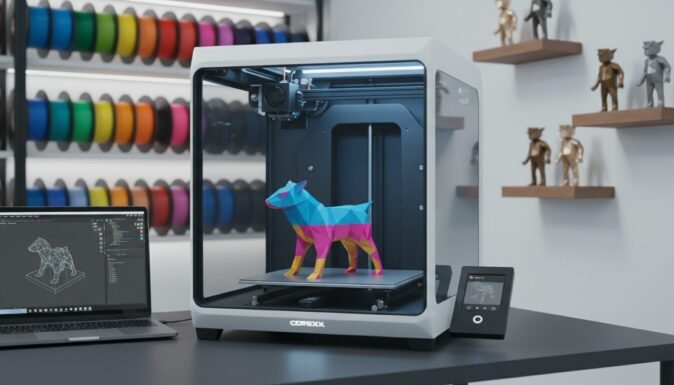
Best Hobby 3D Printers of 2026: The Ultimate Maker’s Guide
In 2026, the world of hobby 3D printing has moved past the era of constant troubleshooting and manual bed leveling. What used to be finicky, slow machines have evolved into powerhouse tools capable of producing industrial-grade detail right on your desk. Whether you are looking to print functional parts in carbon fiber or highly detailed tabletop miniatures, the current market offers unprecedented speed and reliability.
Choosing the right printer now depends more on your specific workflow than just technical specs. In our testing, we found that the gap between “entry-level” and “prosumer” has narrowed significantly, with high-speed CoreXY systems and multi-material capabilities becoming the new standard. Here are the five best hobby 3D printers that actually deliver on their promises this year.
Table of Contents
At a Glance: Top 5 Hobby 3D Printers
| Product Name | Key Features | Ideal Use |
|---|---|---|
| Bambu Lab P1S | 500mm/s Speed, Fully Enclosed, AMS Ready | Reliable, Multi-color daily printing |
| Creality K1C | 600mm/s Speed, Carbon Fiber Ready, AI Camera | High-speed engineering filaments |
| Creality K2 Plus | 16-Color Support, 350mm Build Volume, Active Heating | Large-scale multi-color projects |
| Flashforge Adventurer 5M Pro | 600mm/s Travel, Dual Air Filtration, Beginner-friendly | Schools and indoor home workshops |
| Anycubic Photon Mono M7 Max | 14.7″ Resin Volume, 60mm/h Speed, Auto-fill | Massive high-detail resin models |
Top 5 Best Hobby 3D Printers 2026
🥇 1. Bambu Lab P1S

Best Overall for Reliable Performance: The Bambu Lab P1S remains our top recommendation for makers who want a “no-drama” experience. Its enclosed design and CoreXY motion system allow it to print advanced materials like ASA and ABS without the warping issues common in open-frame printers.
- High-Speed CoreXY System: Reaches speeds of 500mm/s for rapid prototyping.
- Fully Enclosed Design: Provides excellent thermal stability for technical filaments.
- AMS Compatibility: Supports the Automatic Material System for up to 16-color printing.
- 30-Minute Setup: True out-of-the-box experience with minimal assembly required.
| Pros | Cons |
|---|---|
| Exceptional out-of-the-box reliability | Glass door hinge feels slightly fragile |
| Highly effective vibration compensation | Proprietary software ecosystem |
| Sleek, compact footprint for home offices | |
| Smooth integration with AMS multi-color unit |
🥈 2. Creality K1C

Best for Engineering Materials: The “C” in K1C stands for Carbon, and it lives up to the name. We found that the tri-metal “Unicorn” nozzle handles abrasive carbon fiber filaments like PLA-CF and PA-CF with impressive ease, making it a favorite for functional hobbyists.
- Unicorn Nozzle: All-metal integrated design prevents heat creep and clogs.
- AI Camera Monitoring: Detects failures and records timelapses automatically.
- 600mm/s Max Speed: One of the fastest consumer printers in its price bracket.
- Carbon Filtration: Built-in air purifier reduces odors from technical plastics.
| Pros | Cons |
|---|---|
| Exceptional performance with carbon fiber | Cooling fans can be quite loud |
| High-speed printing without quality loss | Occasional firmware bugs |
| Robust all-metal extruder system | |
| Easy-to-use AI monitoring features |
🥉 3. Creality K2 Plus Combo

Best for Large Multi-Color Projects: If you need scale and color, the K2 Plus Combo is a beast. With a generous 350mm³ build volume and the ability to link four CFS units for 16 colors, it handles the most ambitious hobby projects we’ve seen this year.
- Active Chamber Heating: Maintains consistent internal temps for large ABS prints.
- 30,000mm/s² Acceleration: Blistering speed for a machine of this size.
- Dual AI Cameras: Provides 360-degree monitoring for long, multi-day prints.
- Precision Servo Motors: Uses FOC closed-loop motors for ultra-accurate positioning.
| Pros | Cons |
|---|---|
| Massive 16-color material capacity | Significant footprint requires large desk |
| Industrial-grade heated chamber | High price point for hobbyist level |
| High-torque extruder handles any filament | |
| Auto-calibration works flawlessly |
🏅 4. Flashforge Adventurer 5M Pro

Best for Beginners and Classrooms: The Flashforge Adventurer 5M Pro focuses on safety and ease of use. During our testing, we were able to go from unboxing to a finished first print in under 45 minutes, thanks to its foolproof auto-leveling.
- Full-Auto Bed Leveling: Pressure-sensing system ensures a perfect first layer.
- Dual Air Filtration: HEPA and activated carbon filters for safer indoor use.
- Quick-Release Nozzle: Switch between nozzle sizes in seconds without tools.
- PEI Flexible Plate: Makes removing finished prints effortless.
| Pros | Cons |
|---|---|
| Extremely beginner-friendly interface | Build volume is slightly smaller than rivals |
| Excellent air filtration for indoor safety | Proprietary nozzle system can be expensive |
| High-speed travel reduces print times | |
| Very stable all-metal frame |
🏅 5. Anycubic Photon Mono M7 Max
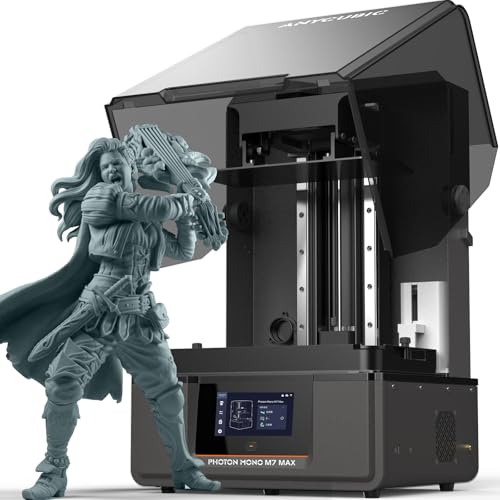
Best for High-Detail Resin Printing: For those who prioritize surface finish over structural strength, the M7 Max is a game-changer. Its massive 14.7-inch build area allows for printing full-sized cosplay helmets or entire squads of miniatures in one go.
- LightTurbo 3.0 System: Delivers 90%+ light uniformity for crisp details.
- 60mm/h High-Speed Printing: Significantly faster than previous generation resin printers.
- Auto Resin Management: Automatically fills the vat and recycles leftover resin.
- Dynamic Temp Control: Maintains optimal resin temperature for consistent curing.
| Pros | Cons |
|---|---|
| Incredible detail for large-scale models | Resin printing requires significant cleanup |
| Fast curing times for such a large volume | Post-processing equipment sold separately |
| Smart resin filling system reduces mess | |
| Excellent light uniformity across the plate |
Final Verdict
For most hobbyists in 2026, the Bambu Lab P1S remains the gold standard for reliability and ease of use. However, if your work involves functional, high-strength parts, the Creality K1C is the superior choice for its carbon-fiber capabilities. For those focused on miniatures and aesthetics, the Anycubic Photon Mono M7 Max offers unmatched scale and detail.
| Product | Best For |
|---|---|
| Bambu Lab P1S | All-around reliability & Multi-color |
| Creality K1C | Engineering & Carbon Fiber filaments |
| Creality K2 Plus | Large-scale multi-color builds |
| Flashforge Adventurer 5M Pro | Beginners and Education |
| Anycubic Photon Mono M7 Max | Detailed miniatures & Large resin props |
FAQs
What is the best hobby 3D printer for beginners in 2026?
The Flashforge Adventurer 5M Pro is widely considered the best for beginners due to its fully automatic leveling and intuitive interface. It offers a plug-and-play experience that minimizes the learning curve associated with 3D printing.
Can hobby 3D printers print carbon fiber?
Yes, modern hobby printers like the Creality K1C are specifically designed with hardened steel nozzles and high-torque extruders to handle abrasive carbon fiber-reinforced filaments like PLA-CF and PA-CF.
Is resin 3D printing better than FDM?
It depends on your goal. Resin (like the Photon Mono M7 Max) is superior for high-detail items like miniatures and jewelry. FDM (like the Bambu Lab P1S) is better for functional parts, toys, and items that need to be durable or multi-colored.
How fast should a hobby 3D printer be in 2026?
In 2026, standard speeds range from 300mm/s to 600mm/s. While top speed is important for quick drafts, the “acceleration” (measured in mm/s²) is often more critical for maintaining print quality on complex shapes.
Do I need an enclosure for my 3D printer?
An enclosure is highly recommended if you plan to print materials like ABS, ASA, or Nylon, as these require a stable, warm environment to prevent warping. It also helps contain noise and fumes.
How much should I spend on a hobby 3D printer?
Quality hobby printers in 2026 range from $350 for entry-level high-speed models to $1,300 for large-scale, multi-material combos. For most users, the $400-$600 range offers the best balance of features and reliability.
Last update on 2026-03-30/Affiliate links / Images from Amazon Product Advertising API