
Massive Charging System : The 5 Best Electric Car Charger Level 2 Hardwired (2026)
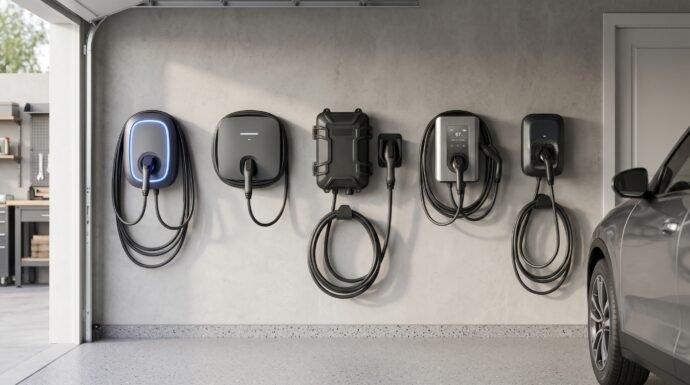
Choosing the Best electric car charger level 2 hardwired, involves more than comparing charging speeds. Buyers should consider maximum amperage, electrical panel capacity, cable length, smart charging features, weather resistance, connector compatibility, and long-term support.
A hardwired EV charger connects directly to a dedicated electrical circuit, providing a permanent home charging setup. Depending on the charger’s output and your vehicle’s onboard charger, a 48-amp unit can deliver up to 11.5 kW, while a 50-amp unit can reach 12 kW at 240 volts. Actual charging speeds and driving range added per hour vary by vehicle and conditions.
Table of Contents
At a Glance
| Product | Key Features | Ideal Use Case |
|---|---|---|
| ChargePoint Home Flex | Adjustable 16–50A output, 23-foot cable, app controls, Wi-Fi | Drivers seeking an established smart-charging system |
| Emporia Pro | Up to 48A, 25-foot cable, Vue 3 energy monitor, PowerSmart load management | Homes needing intelligent electrical load management |
| EVIQO Hardwired | Up to 48A standard output, 25-foot cable, IP66 enclosure, app scheduling | Buyers prioritizing weather protection and adjustable charging |
| Grasside Hardwired | Advertised 48A output, 25-foot cable, display and RFID features | Buyers considering a lower-cost charger with local status information |
| IYILO RA40 | Advertised 48A output, dual temperature sensors, Wi-Fi and RFID | Buyers interested in additional temperature monitoring |
Top 5 Best Electric Car Charger Level 2 Hardwired
1. ChargePoint Home Flex

Overview
The ChargePoint Home Flex is a flexible home charging station for EV owners who want adjustable charging power and app-based controls. Its main advantage is the ability to select an output that fits the home’s electrical capacity instead of automatically opting for the highest available amperage.
ChargePoint documents output settings from 16A to 50A, a 23-foot charging cable, and hardwired installation options. The charger can provide up to 12 kW at 240V when configured for 50A on an appropriately rated circuit.
5 Key Features
- Adjustable charging output: Choose from 16A, 24A, 32A, 40A, 48A, or 50A settings to suit your vehicle and electrical installation.
- Up to 12 kW of power: The maximum 50A setting supports fast home charging when the vehicle can accept that power.
- 23-foot charging cable: Provides flexibility when parking positions and the charging port are not immediately beside the wall unit.
- Smartphone app controls: Adjust charging current, schedule charging, and access supported charging information.
- Hardwired installation: Supports a permanent installation with a suitable dedicated circuit, making it a practical choice for fixed home charging.
Pros
- Wide range of adjustable amperage settings.
- High maximum output for compatible vehicles.
- Long cable helps accommodate different parking arrangements.
- App-based scheduling and charging controls.
Cons
- The highest output requires a suitably rated electrical circuit and may require electrical upgrades.
- Advanced charging features depend on the app and network connectivity.
Best For: EV owners who want a flexible, established home charging system and may value the option to change charging power as their needs evolve.
2. EMPORIA Pro Level 2 EV Charger
Overview
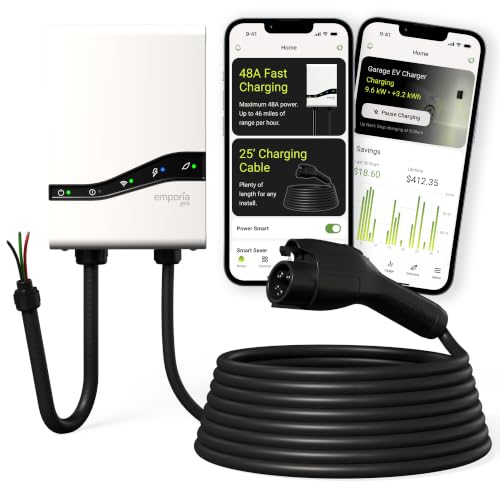
The Emporia Pro is particularly appealing to homeowners who want their EV charger to work alongside the rest of their home’s electrical system. It combines Level 2 charging with the Emporia Vue 3 Home Energy Monitor and PowerSmart load management.
The manufacturer specifies up to 48A and 11.5 kW at 240V, along with a 25-foot cable. PowerSmart monitors household electricity consumption and adjusts charging output to help keep total demand within the home’s available electrical capacity. This can reduce the need for a panel upgrade in suitable installations, although an electrician must determine whether the system is appropriate for a particular home.
5 Key Features
- Up to 48A charging: Delivers up to 11.5 kW at 240V for compatible vehicles and installations.
- PowerSmart load management: Dynamically adjusts charger output according to the home’s available electrical capacity.
- Included Vue 3 energy monitor: Measures household electrical consumption to support load management.
- 25-foot cable: Offers useful reach across a garage or driveway.
- Smart scheduling and solar integration: Supports scheduled charging and charging from surplus solar energy through Emporia’s energy-management ecosystem.
Pros
- Integrated load management can help avoid unnecessary panel upgrades.
- Includes the energy monitor required for PowerSmart.
- Supports charging schedules and energy monitoring.
- Solar-aware charging can help homeowners make better use of excess solar generation.
Cons
- Load management depends on correctly installing and configuring the included monitor.
- The energy-management features may be more than necessary for buyers who simply want basic charging.
Best For: Homeowners who want to manage EV charging alongside household electricity use, especially where panel capacity or solar generation is a concern.
3. EVIQO Hardwired Level 2 EV Charger

Overview
The EVIQO hardwired charger is a strong candidate for buyers who want a high-output charging station with weather protection and app controls. Its documented features include a 25-foot cable, adjustable current settings, a weather-resistant enclosure, and a side reset button.
The manufacturer specifies a standard maximum output of 48A and 11.5 kW at 240V. It also documents an option for 50A operation when configured for a suitable 70A circuit. The unit’s IP66/NEMA 4 enclosure and app-based scheduling are useful considerations for garage or outdoor installations.
5 Key Features
- 48A standard output: Delivers up to 11.5 kW at 240V on an appropriately rated circuit.
- Adjustable charging current: App controls allow users to select a suitable charging rate.
- 25-foot charging cable: Helps reach vehicles parked at different positions.
- IP66/NEMA 4 enclosure: Designed to protect the charger against dust and water exposure in suitable indoor or outdoor installations.
- Smart app and reset button: Provides charging schedules, consumption tracking, and an accessible way to restart the charger.
Pros
- High-output charging for compatible EVs.
- Weather-resistant construction suitable for appropriately installed outdoor use.
- App-based current adjustment and scheduling.
- Convenient side reset button and long cable.
Cons
- Hardwired installation requires appropriate electrical work.
- Smart app features require a compatible 2.4 GHz Wi-Fi connection.
Best For: Homeowners looking for a high-output charger with weather protection, smart controls, and practical installation features.
4. Grasside Hardwired Level 2 EV Charger

Overview
The Grasside hardwired charger is advertised as an 11.5 kW home charging station with a 48A output. Its product listing describes a 25-foot cable, a display for charging information, RFID access cards, and an IP65-rated enclosure. These features could appeal to buyers who prefer seeing charging information on the unit rather than relying entirely on an app.
However, the available information comes from a product listing rather than independently verified manufacturer documentation. Buyers should confirm the exact safety certifications, warranty, electrical requirements, and smart features for the specific model before purchasing.
5 Key Features
- Advertised 48A output: The listing describes 11.5 kW charging at 240V.
- 25-foot cable: Provides additional flexibility for typical home parking arrangements.
- Digital status display: Advertised to show charging and electrical information directly on the unit.
- RFID access cards: Listed as a way to restrict or manage charger access.
- IP65 enclosure rating: Advertised protection against dust and water jets, subject to correct installation and use.
Pros
- Advertised high-output charging.
- Long cable for convenient positioning.
- A display that may make charging information easier to check locally.
- RFID access control is useful for households that want an additional access-management option.
Cons
- Manufacturer documentation and certification details should be independently confirmed before purchase.
- Long-term support, warranty coverage, and app functionality need careful checking.
Best For: Buyers considering a feature-rich, potentially budget-oriented charger who are comfortable verifying its documentation and support arrangements before installation.
5. IYILO RA40 Level 2 EV Charger

Overview
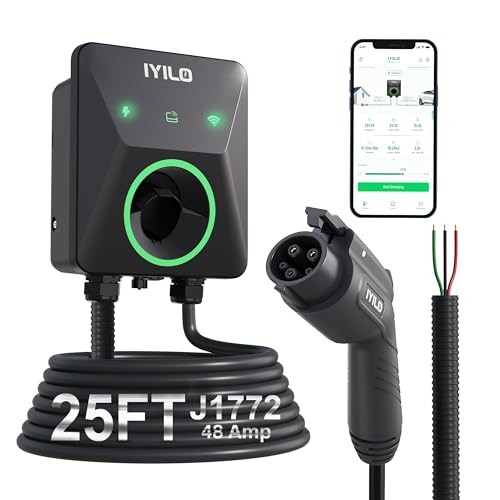
The IYILO RA40 is marketed as a hardwired Level 2 charger with 48A output, Wi-Fi connectivity, RFID access, and temperature monitoring. Its product listing describes a 25-foot cable and a dual-temperature-sensor design intended to monitor heat at the charger and connector.
These features may appeal to buyers who place a high priority on temperature monitoring. However, the available evidence is primarily listing-level information, so the precise sensor behavior, certification status, power-sharing capabilities, and warranty terms should be checked against the supplied manual and current manufacturer documentation before buying.
5 Key Features
- Advertised 48A charging: Listed at 11.5 kW and 240V for compatible vehicles and installations.
- Dual temperature sensors: Marketed as monitoring temperature in two areas of the charging system.
- Wi-Fi and app controls: Listed as providing smart charging and scheduling features.
- RFID access: Advertised access control can help limit who operates the station.
- Advertised power-management features: The product listings describe power sharing and dynamic load balancing; buyers should confirm the exact supported configuration before relying on these functions.
Pros
- Advertised high-output home charging.
- Temperature monitoring is a notable differentiator.
- Smart controls and RFID access are listed features.
- Advertised power-management functions may be useful in multi-charger installations if properly supported.
Cons
- Independent technical verification of the temperature-monitoring and load-management functions is limited.
- Buyers should confirm certification, warranty coverage, and the availability of manufacturer support.
Best For: Buyers interested in additional temperature monitoring and smart features who are willing to verify the technical documentation before committing to installation.
Final Verdict
There is no single best hardwired Level 2 EV charger for every household. The right choice depends on electrical capacity, desired charging speed, smart-home requirements, installation conditions, and confidence in the manufacturer’s documentation.
- Best for adjustable charging power: ChargePoint Home Flex. Its broad amperage range and 50A maximum make it a flexible option for homeowners with a suitable electrical circuit.
- Best for household energy management: Emporia Pro. Its included Vue 3 monitor and PowerSmart load management are its strongest differentiators.
- Best for outdoor-oriented installations: EVIQO. Its documented weather-resistant enclosure, adjustable current, and app controls make it a compelling choice.
- Best for buyers who want a display: Grasside. Its listing advertises a digital display and RFID access, but certification and warranty details deserve extra scrutiny.
- Best for buyers prioritizing additional temperature monitoring: IYILO RA40. Its dual-sensor claims are interesting, but the precise implementation and supporting documentation should be verified.
For most homeowners comparing established, documented options, I would start with ChargePoint Home Flex and Emporia Pro. Consider EVIQO if weather resistance and its installation features matter most. Treat Grasside and IYILO as options that warrant additional due diligence before purchase.
Best For Table
| Buyer Type / Scenario | Best Product | Why |
|---|---|---|
| Adjustable charging requirements | ChargePoint Home Flex | Multiple amperage settings up to 50A |
| Limited electrical panel capacity | Emporia Pro | PowerSmart dynamically manages household electrical load |
| Outdoor installation | EVIQO | Documented IP66/NEMA 4 enclosure |
| On-unit charging information | Grasside | Product listing advertises a digital display |
| Additional temperature monitoring | IYILO RA40 | Product listing advertises dual temperature sensors |
| Solar-aware energy management | Emporia Pro | Supports charging from surplus solar energy |
| Buyer prioritizing documented product specifications | ChargePoint or Emporia | Detailed manufacturer specifications are available |
FAQs
1. Is a hardwired Level 2 EV charger better than a plug-in charger?
A hardwired charger provides a permanent installation without a separate charging receptacle. It can also support higher charging currents on compatible models. A plug-in charger may be easier to remove or relocate, so the better choice depends on your installation, electrical code, and future plans.
2. What size breaker do I need for a 48A EV charger?
A 48A continuous charging load generally requires a 60A dedicated circuit under the common 80% continuous-load rule. A licensed electrician should confirm the applicable code, conductor sizing, charger instructions, and panel capacity before installation.
3. Will a 48A charger work with every electric car?
Not necessarily at its maximum output. The vehicle must support the charger’s connector standard and the available AC charging power. Some vehicles accept less power than the station can provide, and connector compatibility may require an appropriate adapter.
4. Can a smart EV charger prevent an electrical panel upgrade?
Not automatically. A charger with dynamic load management, such as Emporia Pro with its included Vue monitor, can adjust charging output according to household electrical demand. Whether that eliminates the need for an upgrade depends on the existing installation, applicable code, and the load-management system’s approved configuration.
5. Is a weatherproof charger safe to install outdoors?
A suitable outdoor-rated charger can be installed outdoors when its enclosure rating, mounting, wiring, circuit protection, and installation instructions are followed. An IP rating alone does not establish that every installation condition is safe. Have a qualified electrician confirm suitability for the intended location.
6. What should I check before buying a hardwired EV charger?
Confirm the maximum charging current, required breaker and wiring, connector compatibility, cable length, weather rating, certification, warranty, Wi-Fi requirements, and manufacturer support. Also check whether any advertised load balancing or temperature monitoring requires additional hardware or has specific installation limitations.
Last update on 2026-10-24/Affiliate links / Images from Amazon Product Advertising API